
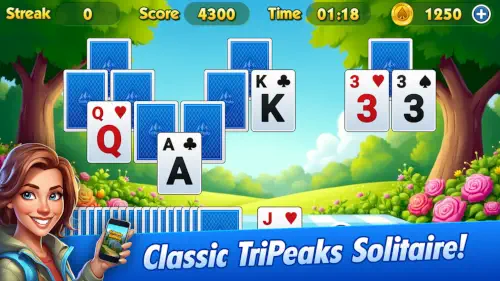
TriPeaks Solitaire Challenge is a straightforward offline TriPeaks card game from Giantix Studios that puts the cards first, not a complicated meta game.

In this TriPeaks Solitaire Challenge the attraction is easy to understand: clear three overlapping pyramids by matching exposed cards one rank higher or lower, then keep the board moving before the stock runs dry. Large, easy to read cards, serene farm scenes, tropical Tiki islands, and underwater backgrounds give the classic rules a more relaxed visual setting without getting in the way of the solitaire experience.
What Is TriPeaks Solitaire Challenge?
Giantix Studios and the Game’s Core Concept
TriPeaks Solitaire Challenge comes from Giantix Studios, a developer based in Mannheim, Germany, and its design philosophy is noticeably more focused than that of many modern solitaire games. Instead of surrounding every round with layers of companions, currencies, social competitions, or elaborate progression systems, it concentrates on the traditional TriPeaks card game itself.
That simplicity is important because it makes the game easy to understand almost immediately. The player deals with the tableau, searches for useful card matches, exposes covered cards, and decides when using the stock pile is worth the risk. The result is an experience that feels closer to a dedicated solitaire card game than a large mobile game built around solitaire.
A Classic TriPeaks Card Game
At the heart of TriPeaks Solitaire Challenge is the familiar three peak layout. The tableau contains 28 cards arranged into three overlapping pyramids, with covered cards gradually becoming available as the cards blocking them are removed. The objective is to clear the entire playing field rather than simply collect individual matches.
One Rank Matching
The central rule is simple: an exposed card can be played when it is one rank higher or one rank lower than the card currently sitting on top of the waste pile. A 7 can therefore follow a 6 or an 8, while the suit and color have no effect on whether the move is valid.
That one rank rule creates the game’s real decision making. A move may be legal but still be a poor choice if it fails to uncover another card or leaves the next waste pile card with few possibilities.
Three Overlapping Pyramids
The three peaks are more than a visual signature. Their overlapping arrangement determines which cards become available and which remain trapped underneath other cards. Removing an exposed card can reveal another card above it, gradually opening routes through the tableau.
The best rounds therefore feel less like randomly clicking cards and more like finding a route through the three pyramids. Every successful removal can create another opportunity, but the wrong sequence can leave the board dependent on the stock pile.
Stock and Waste Piles
When there is no useful tableau match, the stock pile provides the next card for the waste pile. TriPeaks Solitaire Challenge uses a 24 card stock, giving players a limited supply of new ranks to work with.
The stock should not be treated as an unlimited safety net. Players can cycle through it twice, so every draw matters when several cards are still covering the peaks.
Why Stock Management Matters
A strong run can remove several cards without touching the stock, preserving those future draws for moments when the tableau stops producing useful matches. This gives even the straightforward TriPeaks rules a small layer of resource management.
An Offline Solitaire Adventure
One of the clearest reasons to consider TriPeaks Solitaire Challenge offline is that the game is designed to work without an internet connection. That makes it particularly suitable for quiet sessions when connectivity is unavailable or when a player simply wants a solitaire game without depending on an online connection.
Solitaire Without an Internet Connection
Offline play changes the rhythm of the experience. There is no need to treat a short solitaire session as an online activity; the focus remains on the tableau, the next possible match, and the stock cards still available.
For players who prefer a calm card game during travel, downtime, or short breaks, this approach is refreshingly uncomplicated.
Who Is TriPeaks Solitaire Challenge Designed For?
TriPeaks Solitaire Challenge is positioned broadly enough to work for newcomers and experienced solitaire players, but its presentation makes it particularly approachable for anyone who values readability over visual clutter. The large cards and easy-to-read designs make the tableau easier to follow, while simple responsive controls reduce the learning curve.
TriPeaks Solitaire Challenge for Seniors
The large card presentation is especially relevant to searches for TriPeaks Solitaire Challenge for seniors. Rather than relying on tiny card symbols or complicated interfaces, the game emphasizes clear visibility, making the important information on each card easier to recognize during a round.
A Comfortable Starting Point for Beginners
Beginners also benefit from the game’s straightforward structure. There are no complicated card combinations to memorize: the essential decision is whether an exposed card is one rank above or below the current waste card. Once that becomes familiar, the deeper challenge comes from choosing which valid card to play first.
A Simple Challenge for Experienced Players
Experienced TriPeaks fans can still find strategy in the apparently simple rules. The limited stock, three connected peaks, covered cards, and requirement to clear all 28 tableau cards reward players who think beyond the immediate match.
That balance is ultimately what defines TriPeaks Solitaire Challenge: it does not need an elaborate meta game to make a familiar solitaire format engaging. Its appeal comes from making the classic TriPeaks puzzle clear, readable, portable, and easy to return to whenever a quick card-game session sounds better than a more complicated mobile experience.
TriPeaks Solitaire Challenge Gameplay
TriPeaks Solitaire Challenge delivers a straightforward TriPeaks solitaire experience built around one simple objective: clear the three peaks before your stock resources run dry. The TriPeaks Solitaire Challenge gameplay revolves around recognizing one-rank matches, uncovering blocked cards, and deciding when to spend the limited stock. There are no complicated card suits to track and no overloaded progression system distracting from the board. Instead, Giantix Studios keeps the focus on the familiar rhythm of revealing cards, extending chains, and finding the move that opens the next part of the tableau.
How the TriPeaks Card Layout Works
Three Overlapping Pyramids
The playing field contains 28 tableau cards arranged into three overlapping pyramids, creating the distinctive TriPeaks shape. Each peak rises from a small triangular formation, while the three structures connect through their lower cards. The arrangement is important because many cards are initially hidden behind others, meaning the cards you can see are only part of the puzzle.
The three peaks are not simply three separate groups to clear independently. Their overlapping structure means a move in one area can expose cards that influence what is possible elsewhere. During a typical TriPeaks Solitaire Challenge gameplay session, the strongest moves are often the ones that remove a blocker and immediately create another playable opportunity.
Why the Three Peaks Matter
The three-peak layout gives the game more decision-making than simply matching whatever card happens to be available. A card sitting underneath several covered cards can be more valuable than another card that extends a short chain because removing it may reveal additional options.
Think Beyond the Current Match
The useful question is not only “Can I play this card?” but also “What does playing this card reveal?” That small change in thinking turns the three pyramids into a genuine card-management puzzle.
The Base Row
The base row contains the exposed cards at the bottom of the tableau and provides most of the opening moves. Because these cards are immediately available, they determine which card chains can begin before you need to rely on the stock pile.
A strong opening involves scanning the entire base rather than automatically choosing the first legal match. If several cards can be played, the better choice may be the one that removes a blocker above another section of the pyramid. This is particularly important when comparing a short card chain with a move that exposes a previously hidden card.
The First Moves Set the Tone
The opening cards effectively determine how much freedom you have later. Removing several connected cards from the base can create a long run, while spending the same opportunity on isolated cards may leave the peaks difficult to open.
Face Down Cards
The tableau contains 18 face down cards above the base, and these hidden cards become available only when the cards covering them are removed. This creates the central reveal mechanic of TriPeaks: clearing visible cards is valuable because it changes what you can see and play next.
The face down cards are therefore more than hidden obstacles. They represent potential future moves. A card that looks unimportant on the surface can become the key to opening an entire section of a peak.
Opening Covered Cards
When choosing between two legal moves, favor the move that exposes more of the tableau whenever the surrounding ranks support it. This approach keeps the board expanding instead of allowing the game to stall after a few attractive matches.
How Card Matching Works
The One Rank Matching Rule
The heart of TriPeaks Solitaire Challenge gameplay is the one rank matching rule. You can remove an exposed tableau card when its rank is exactly one higher or one lower than the card currently sitting on top of the waste pile.
For example, if the waste pile shows a 7, you can play either a 6 or an 8 from the exposed tableau. Once that card is played, it becomes the new reference card, so the next move must again be one rank above or below it.
Building a Chain
This creates the satisfying chain reaction that makes TriPeaks different from many slower solitaire formats. A 7 can lead to an 8, the 8 can lead to a 9, and the 9 can lead to a 10 without drawing from the stock in between.
The Longer the Chain, the Better
A long uninterrupted sequence removes more tableau cards while consuming no additional stock cards. That makes chain-building one of the most important skills for players learning how to play TriPeaks Solitaire Challenge efficiently.
Suits and Colors Do Not Matter
Unlike traditional Klondike style solitaire, TriPeaks Solitaire Challenge does not require matching suits or colors. Hearts, diamonds, clubs, and spades have no influence on whether a card can be played.
The only question is its rank relative to the current waste pile card. That keeps the rules easy to understand while leaving room for strategic decisions about which matching card should be played first.
Rank Is the Only Matching Requirement
If the waste card is a 10, any exposed 9 or Jack is potentially playable regardless of its suit or color. This simplicity is one reason the game works well as an accessible offline solitaire option.
Exposed Cards Only
A card cannot be selected simply because its rank matches. It must also be uncovered and exposed. Face down cards remain unavailable until the cards positioned over them have been cleared.
This rule gives every move a second layer of importance. A legal match that reveals two new cards can be considerably stronger than an equally legal match that leaves the rest of the tableau unchanged.
Clear the Blockers
Think of covered cards as locked opportunities. Removing the cards directly blocking them gradually transforms the board from a limited collection of visible choices into a much larger set of possible matches.
King to Ace Connection
Under the relevant TriPeaks rules, King and Ace can connect as consecutive ranks, creating a circular link at the end of the sequence. This means an Ace can lead into a King, or a King can lead into an Ace, when the rule is active.
That connection can be especially valuable when a long chain appears to have reached its natural endpoint. Instead of treating Ace and King as completely separate ends of the ranking system, experienced players can use the wrap around relationship to keep a sequence alive.
Use the Wrap as a Chain Extension
A King to Ace move should not automatically be spent simply because it is available. Sometimes the Ace or King is more valuable as a bridge into another section of the tableau, particularly when several cards can follow the resulting waste pile rank.
Managing the Stock and Waste Piles
The 24 Card Stock Pile
When no useful exposed tableau card is available, the 24 card stock pile gives you another card to work with. The stock is face down, so each draw introduces a new unknown rank and potentially changes the direction of the round.
The important point is that the stock is not an unlimited source of second chances. You have a restricted number of opportunities to cycle through it, making every draw part of the overall puzzle.
Treat Stock Cards as a Resource
A player who immediately draws whenever the board offers no obvious match can burn through useful opportunities quickly. A better approach is to examine every exposed card before committing to the next stock card.
Starting the Waste Pile
The waste pile establishes the active rank for card matching. Once a face-up card begins the pile, every subsequent tableau move must be one rank higher or lower than its current top card.
Because the top waste card changes after every successful match, the waste pile effectively controls the direction of your card chain.
The Waste Card Is Your Current Key
A 6 on top of the waste pile makes 5 and 7 valuable. If you play the 7, the target immediately changes to 6 or 8. Good play therefore involves constantly reassessing the board after every removal rather than following a fixed sequence.
Two Stock Passes
The game allows players to cycle through the 24-card stock pile twice. That limitation makes stock management a defining part of the challenge rather than a minor convenience.
A successful round is therefore not simply about finding enough matches. You must clear the tableau while making those two stock passes last long enough to reach the remaining cards.
Every Draw Has a Cost
Using a stock card means giving up one opportunity that could have been useful later. When several tableau cards can still be played, extending the existing chain is generally preferable to drawing another card immediately.
Knowing When to Draw
Drawing at the wrong moment can break the momentum of a promising sequence. If an exposed 8 can be followed by a 9 and then a 10, drawing a new card before exploring that sequence wastes the opportunity to clear several cards without spending the stock.
At the same time, refusing to draw when the tableau has genuinely run out of legal moves accomplishes nothing. The goal is to recognize the difference between “I don’t see a move immediately” and “there are no useful exposed moves left.”
Draw With a Purpose
Before drawing, scan the three peaks and check every exposed card against the current waste card. If no legal continuation exists, use the stock to reset the matching opportunity. This simple habit can make a noticeable difference when attempting a difficult TriPeaks Solitaire Challenge round.
How You Win a TriPeaks Solitaire Challenge Round
Clearing All 28 Tableau Cards
The win condition is straightforward: remove all 28 cards from the three-pyramid tableau. Every peak must be cleared, including the cards that began face down.
The challenge lies in reaching that final card without exhausting your available stock passes. A round can feel almost complete and still fail if the remaining cards cannot be connected to the waste pile before the stock resource disappears.
The Final Cards Still Matter
Do not treat the last few tableau cards as an afterthought. A poorly chosen earlier move can leave an isolated rank that becomes impossible to reach, even when most of the board has already been cleared.
What Happens When the Stock Runs Out?
The stock provides only limited opportunities to restart your card chain. If the available two stock passes have been exhausted and cards remain on the tableau, the round ends unsuccessfully.
This is why simply maximizing the number of cards removed per move is not enough. The best strategy balances immediate clearance with preserving enough flexibility to deal with the cards that remain deeper inside the peaks.
Stock Exhaustion Is the Real Pressure Point
When the stock is running low, shift your attention toward the most obstructed parts of the tableau. Continuing a flashy chain is less important if another move would expose the final hidden cards you need to finish the round.
Why Board Exposure Matters
The strongest TriPeaks Solitaire Challenge tips revolve around board exposure because every face-down card represents another potential route toward completing the round. Removing a card that uncovers two others can create far more value than removing a card that simply extends the current chain by one.
This is where the game’s simple rules become surprisingly strategic. You are constantly choosing between clearing cards now and creating better choices for later. The player who learns to prioritize exposure, preserve the stock, and recognize long chains has a much better chance of clearing all three peaks before the available resources disappear.
The Best Move Opens the Next Move
That is the central idea behind effective TriPeaks play: don’t judge a card only by what it removes. Judge it by what it makes possible afterward.
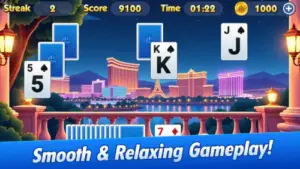
TriPeaks Solitaire Challenge Gameplay Strategy
Beginner TriPeaks Solitaire Challenge Tips
Start With the Exposed Base Row
The strongest TriPeaks Solitaire Challenge tips for beginners start with the cards you can already see. Before touching the stock pile, scan the entire exposed base row and identify every possible one rank match with the current waste pile card. This first inspection can reveal whether you have a short move or the beginning of a much longer chain. Because every card removed from the base can potentially uncover another card above it, the best opening is rarely about simply playing the first legal move.
Read the Board Before Playing
Look across all three peaks rather than focusing on one side. A base card that appears less attractive may be the better choice if removing it exposes two additional tableau cards. That makes board awareness more important than speed.
Look for the Longest Card Chain
A long card chain is one of the most valuable opportunities in TriPeaks Solitaire Challenge gameplay. If the waste pile shows a 7, for example, and the exposed tableau contains a 6 followed by a 5 and then a 4, those consecutive matches can remove several cards without requiring another stock draw. Every successful continuation keeps the current waste card moving and preserves your limited stock for later.
Chain Length Can Change the Whole Board
The real reward is not simply the number of cards removed. A long sequence can reach cards positioned beneath the peaks and open previously covered areas. When two legal moves are available, the chain that also exposes new cards is usually the more useful play.
Open Covered Cards First
Removing an exposed card feels immediately rewarding, but TriPeaks Solitaire Challenge strategy becomes much stronger when you consider what that removal reveals. Covered cards are inaccessible until their blockers disappear, so a move that opens a new card can create several future possibilities.
Think Beyond the Current Move
If one playable card removes itself while another playable card unlocks two hidden cards, the second option often has greater strategic value. You are not merely clearing the tableau; you are increasing the number of cards available for your next decisions.
Clear Blockers Near the Peaks
Cards close to the base of a peak can act as major blockers. Removing the right one may expose cards higher in the pyramid and create a sequence that was previously impossible. This is particularly important when one base card supports access to several cards farther up the same peak.
Choose the Blocker With the Biggest Payoff
Do not judge a blocker only by its rank. Consider what sits behind it. A card that unlocks multiple positions can be more valuable than another card that happens to continue a short chain.
Work Across All Three Peaks
It is tempting to attack one peak until it disappears, but concentrating too heavily on a single section can leave the other two peaks untouched and increasingly difficult to access. Working across all three peaks keeps more of the tableau open and gives the waste pile more opportunities to connect with available ranks.
Keep the Tableau Flexible
The goal is not necessarily to clear the left, center, or right peak first. The stronger objective is to maintain several possible routes through the board so that one unlucky waste-pile card does not completely stop your progress.
Save King and Ace Opportunities
The King Ace connection can create an important bridge in a TriPeaks card sequence when that rule is active. A King can connect to an Ace, and an Ace can connect back toward a King, potentially extending a chain that would otherwise end.
Do Not Break a Useful Pivot Too Early
If an Ace or King can serve as a bridge between otherwise separate sequences, think carefully before using it. Saving that pivot for the right moment can turn a stalled board into a successful run.
Do Not Waste Stock Cards
The 24-card stock pile is not an unlimited safety net. With only two available passes, every unnecessary draw reduces the options you will have later in the round. One of the most useful TriPeaks Solitaire Challenge tips is therefore simple: exhaust worthwhile tableau moves before drawing whenever possible.
Treat the Stock as a Strategic Resource
Drawing immediately because no obvious move appears on one part of the board can be a mistake. Scan all three peaks first. There may be a legal card elsewhere that continues the current chain and saves the stock for a more difficult position.
Advanced TriPeaks Solitaire Challenge Strategy
Plan Several Matches Ahead
Experienced players should avoid evaluating a move only by whether it is legal. Before selecting a card, mentally trace the possible sequence that could follow it. If a 9 can remove an 8, ask whether a 7 is exposed afterward and whether that 7 can uncover another useful card.
Trace the Chain Before Committing
This approach is especially powerful when several exposed cards share related ranks. A move that looks attractive immediately may terminate after one card, while another opening move can produce a much longer sequence and expose more of the tableau.
Prioritize Moves That Reveal More Cards
The strongest advanced TriPeaks Solitaire Challenge gameplay strategy treats card exposure as a major objective. Clearing a card is useful, but clearing a card that unlocks two previously covered positions can dramatically increase your future choices.
Exposure Beats Empty Progress
When two cards can both be removed, compare what each removal reveals. The move that creates more playable cards generally gives you greater flexibility, even if it produces a shorter immediate combo.
Track the Remaining Stock
As the round progresses, the number of stock cards remaining becomes increasingly important. Early in the game, a draw can feel inexpensive. Near the end, however, spending another stock card may leave you without enough opportunities to reach the remaining tableau.
Watch the Endgame Carefully
If several cards remain on the peaks while the stock is nearly exhausted, stop thinking about individual matches and start thinking about clearance. Prioritize moves that open blocked areas and preserve every remaining stock opportunity for a meaningful transition.
Use the Two Pass Limit Strategically
The two-pass stock limitation changes how you should approach the entire round. You are effectively managing a finite supply of chances to change the waste-pile card. Spending those chances too freely can make an otherwise promising board impossible to finish.
Make Each Pass Count
A useful rhythm is to clear as many productive tableau cards as possible, use the stock when the board genuinely stalls, then reassess the newly available cards. The objective is to make each stock pass create access rather than simply consume cards.
Build Chains Before Drawing
The most reliable advanced habit is to search the tableau thoroughly before touching the stock. Every available one-rank match can potentially extend a chain, uncover a hidden card, and move you closer to clearing all 28 tableau cards without spending another stock card.
Save the Stock for Genuine Dead Ends
When no productive tableau move remains, drawing becomes necessary. Until that point, the stock is better viewed as a reserve than a convenience button. This disciplined approach gives you more control over the final stages of a TriPeaks Solitaire Challenge round and can make the difference between clearing the three peaks and running out of stock with cards still remaining.
TriPeaks Solitaire Challenge Graphics and Design
Clean Card Graphics
TriPeaks Solitaire Challenge keeps its visual presentation focused on the part of the screen that matters most: the cards. The card faces use a clean, straightforward design that makes rank recognition quick, which is especially important in a game where every move depends on identifying whether an exposed card is exactly one rank higher or lower than the waste-pile card.
Clarity That Supports Card Matching
There is little visual clutter competing with the tableau. The three overlapping peaks remain easy to read, while the card graphics make the central matching mechanic immediately understandable. That simplicity suits players searching for a TriPeaks Solitaire Challenge review focused on classic gameplay rather than a heavily layered solitaire interface.
Designed Around the Rank
Because suits and colors do not determine whether a card can be played, recognizing the rank quickly is the priority. The clean presentation helps players scan the exposed cards and make decisions without having to decipher overly decorative card faces.
Large Cards and Readability
One of the most practical visual choices in TriPeaks Solitaire Challenge gameplay is its use of large, easy to read cards. The larger presentation is particularly useful on smaller mobile screens, where tightly packed cards can make the three-peak arrangement difficult to follow.
A More Accessible TriPeaks Board
Large cards also give the game a clear accessibility advantage for beginners and seniors. The player can identify ranks without constantly zooming in or struggling with tiny symbols, while the straightforward layout keeps the essential information visible during a round.
Why Card Size Matters in TriPeaks
TriPeaks requires constant comparison between the waste pile card and multiple exposed tableau cards. If those ranks are difficult to read, the strategic part of the game becomes unnecessarily frustrating. Here, readability directly supports the card matching experience rather than functioning as a cosmetic feature.
Farm, Tiki Island, and Underwater Visuals
The game’s visual variety comes from three supplied theme concepts: serene farm, tropical Tiki island, and underwater world. Each gives the same classic TriPeaks board a different atmosphere without changing the underlying card mechanics.
Serene Farm Theme
The farm setting gives the solitaire adventure a calm, rural backdrop. It works particularly well for players who prefer a peaceful environment behind their card game rather than an intense or competitive visual style.
Tropical Tiki Island Theme
The tropical Tiki island setting moves the experience toward a brighter holiday atmosphere. Its tropical presentation provides a noticeable change from the quieter farm environment while keeping the cards themselves at the center of attention.
Underwater World Theme
The underwater world offers the strongest contrast of the three concepts, surrounding the familiar TriPeaks layout with an aquatic setting. It gives repeated sessions more visual variation without turning the background into a distraction.
Three Themes, One Familiar Board
The important detail is that these themes change the presentation, not the rules. Whether the player is surrounded by a farm, Tiki island, or underwater setting, the same 28 card TriPeaks challenge remains underneath.
TriPeaks Solitaire Challenge vs Similar Games
TriPeaks Solitaire Challenge vs Solitaire Grand Harvest
TriPeaks Card Gameplay
TriPeaks Solitaire Challenge and Solitaire Grand Harvest share the same fundamental TriPeaks appeal: cards are removed by matching an exposed card one rank higher or lower than the current waste-pile card. In both games, the satisfaction comes from spotting consecutive matches and turning a small opening into a longer clearing sequence.
The difference becomes more noticeable once you look beyond the tableau. TriPeaks Solitaire Challenge gameplay keeps the card board at the center, while Solitaire Grand Harvest surrounds its TriPeaks rounds with considerably more progression and farm oriented systems.
The Better Choice for Classic TriPeaks Fans
Players who primarily want the card mechanics, readable cards, and a relatively uncluttered experience may find TriPeaks Solitaire Challenge easier to settle into. Those who want the solitaire board to feed into a larger progression loop have a stronger reason to choose Solitaire Grand Harvest.
Farm Theme and Progression
Both games use farm imagery, but the role of that theme is fundamentally different. In TriPeaks Solitaire Challenge, the farm is a visual theme that changes the atmosphere surrounding the cards. It does not turn the game into a separate farm-management experience.
Solitaire Grand Harvest takes the farm concept much further by making farm development part of the game’s larger progression. Solitaire victories contribute to an expanding virtual farm, giving players an additional reason to keep completing levels.
Background Versus Meta Game
That distinction matters when choosing between them. If you are searching for a TriPeaks solitaire game with farm themes but want the cards to remain the main attraction, TriPeaks Solitaire Challenge is the more focused option. If building and expanding a farm is part of what makes solitaire enjoyable for you, Solitaire Grand Harvest offers the deeper loop.
Offline Simplicity vs Feature Rich Progression
TriPeaks Solitaire Challenge’s offline first approach favors players who want a straightforward card game that does not require an elaborate progression ecosystem. Solitaire Grand Harvest is better suited to players who enjoy rewards, additional systems, and a more developed long-term progression structure.
Two Different Solitaire Philosophies
The choice is essentially between focused TriPeaks simplicity and TriPeaks wrapped in a larger game world. Neither approach is inherently superior; they serve different types of solitaire players.
TriPeaks Solitaire Challenge vs Solitaire TriPeaks Journey
Core TriPeaks Mechanics
At the card table level, the two games are closely related. Both use the familiar one rank matching rule, where an exposed card can be played when its rank is immediately above or below the card currently sitting on the waste pile.
That means someone comfortable with one game can move to the other without relearning the basic TriPeaks rhythm. The real differences appear in everything surrounding those card decisions.
Journey and Companion Systems
TriPeaks Solitaire Challenge keeps its adventure elements comparatively visual, using farm, tropical Tiki island, and underwater backgrounds to change the setting around the board.
Solitaire TriPeaks Journey builds a much stronger journey identity around its progression, including companions, animated destinations, rewards, and other systems designed to make the card rounds feel like part of a larger adventure.
Which Experience Feels More Focused?
Players searching for TriPeaks Solitaire Challenge offline gameplay may prefer its simpler structure. Players who want companions and a stronger sense of moving through an ongoing journey may find Solitaire TriPeaks Journey more engaging over extended play.
Solo Relaxation vs Social Competition
If you want to play TriPeaks without worrying about online interaction, the Challenge format has an obvious advantage. If leaderboards, friends, and competitive elements make solitaire more motivating, the Journey approach offers more around the core card game.
TriPeaks Solitaire Challenge vs Solitaire Cruise Tripeak
TriPeaks Rules
Both games build their gameplay around the recognizable TriPeaks formula. The player works through exposed cards, searches for one-rank matches, and manages the stock when no useful tableau move remains.
The important distinction is not the basic card logic but the way each game uses its theme and progression to frame those rounds.
Themed Locations
TriPeaks Solitaire Challenge uses three clearly defined visual concepts in the supplied research: a serene farm, tropical Tiki island, and underwater world. These settings provide atmospheric variety while leaving the solitaire board itself largely unchanged.
Solitaire Cruise Tripeak takes a more travel-oriented approach, making destination discovery a more central part of its identity.
Different Reasons to Keep Playing
TriPeaks Solitaire Challenge is closer to themed offline solitaire, where the background complements the card game. Solitaire Cruise Tripeak is more appealing to players who want the feeling of traveling through different destinations as part of their progression.
Feature Depth
This is where the two experiences can appeal to different audiences. TriPeaks Solitaire Challenge deliberately keeps its feature set relatively straightforward, while feature rich TriPeaks alternatives tend to add more rewards, progression systems, events, or social mechanics.
Simplicity Has a Place
For a player looking for a simple TriPeaks solitaire game without internet, fewer systems can actually be the attraction. Players who want constant progression layers may find the broader feature set of a themed rival more compelling.
TriPeaks Solitaire Challenge vs Solitaire by MobilityWare
Classic Solitaire vs TriPeaks
The biggest difference is immediately visible on the card table. TriPeaks Solitaire Challenge uses the distinctive three peak pyramid layout, while Solitaire by MobilityWare is centered on classic solitaire experiences and their familiar tableau structure.
This is not simply a cosmetic distinction. TriPeaks asks players to create chains by matching adjacent ranks, whereas classic Klondike style solitaire relies on a different system of building and moving cards between tableau columns.
Choosing the Right Solitaire Format
If you specifically want TriPeaks, Solitaire by MobilityWare is not a direct substitute for the same card puzzle. It makes more sense for players who want traditional solitaire and multiple classic style modes.
Daily Gameplay
The repeat play experience also differs. TriPeaks Solitaire Challenge focuses on replaying its core card-clearing challenge with themed presentation and offline accessibility.
Solitaire by MobilityWare has a broader traditional solitaire ecosystem and is more closely associated with recurring challenges and varied classic solitaire play.
Different Kinds of Replayability
TriPeaks Solitaire Challenge gets much of its replay value from the puzzle itself: finding better chains, managing stock passes, and clearing the tableau efficiently. MobilityWare’s approach places more emphasis on variety within classic solitaire.
Accessibility
TriPeaks Solitaire Challenge has a particularly clear accessibility angle through its large, easy-to-read cards and simple controls. That presentation is useful for seniors, beginners, and anyone who finds small mobile card interfaces uncomfortable.
A Strong Choice for Readability
For someone specifically searching for TriPeaks Solitaire Challenge for seniors, the large card presentation is one of the game’s clearest differentiators. The focus is not on adding complexity but on making the actual cards easier to see and use.
TriPeaks Solitaire Challenge vs Online TriPeaks Games
Offline App vs Browser Based Solitaire
An installed game such as TriPeaks Solitaire Challenge offers a different experience from browser based TriPeaks games. The app is designed to be available directly on the device, while online versions are accessed through a web browser and generally depend on an active connection.
For players who want to play TriPeaks during travel or in locations with unreliable connectivity, that distinction can be more important than cosmetic differences.
No Browser Required
The appeal of an offline app is simple: open the game and play. There is no need to locate a browser version every time you want a quick round.
Stock Management
The stock pile gives TriPeaks its resource management element. In TriPeaks Solitaire Challenge, the 24 card stock acts as a finite safety net when the tableau does not offer a useful match, with the supplied research describing two available passes through the stock.
That limitation makes every draw meaningful. Experienced players can preserve stock opportunities by exhausting worthwhile tableau moves before turning to the next card.
The Stock Is Part of the Puzzle
A player who draws whenever the board becomes slightly inconvenient can quickly burn through valuable opportunities. A player who delays stock use while productive chains remain available has more room to recover later.
No Internet Convenience
The strongest reason to choose TriPeaks Solitaire Challenge over a browser-based alternative is its offline focus. Players searching specifically for TriPeaks Solitaire Challenge offline can enjoy the core card game without treating an internet connection as a prerequisite.
Solitaire That Travels With You
That makes the game particularly practical for flights, commutes, trips, or quiet moments where connectivity is uncertain. Instead of competing with online TriPeaks games on the number of features, TriPeaks Solitaire Challenge makes a simpler promise: large, readable cards, familiar three peak gameplay, themed backgrounds, and a solitaire experience that works without the internet.
Conclusion
A Straightforward TriPeaks Experience With a Clear Identity
TriPeaks Solitaire Challenge knows exactly what kind of solitaire game it wants to be. Instead of surrounding the card table with a huge progression ecosystem, it keeps the focus on the familiar three-peak layout, one-rank card matching, stock management, and the simple satisfaction of clearing the tableau.
That restraint is part of its identity. The game still gives the experience some personality through its serene farm, tropical Tiki island, and underwater backgrounds, plus customizable backgrounds, card backs, and card styles. But these elements support the solitaire experience rather than competing with it.
The strongest reason to try it is also the simplest: TriPeaks Solitaire Challenge puts the card game first, and for many solitaire players, that is exactly what makes it worth playing.
FAQ
Where can I get the TriPeaks Solitaire Challenge download?
You can get the TriPeaks Solitaire Challenge download directly from Google Play. The official listing identifies Giantix Studios as the developer and currently lists the game as available for Android, with a PC version available through Google Play Games.
Is TriPeaks Solitaire Challenge playable offline?
Yes. Offline play is one of the game’s defining features. The Google Play listing specifically promotes playing TriPeaks Solitaire without an internet connection, making it suitable for travel, commutes, or relaxing when Wi-Fi is unavailable.
What are the rules in TriPeaks Solitaire Challenge?
The objective is to clear the three peaks by selecting exposed cards that are one rank higher or one rank lower than the card currently on the waste pile. Suits do not determine whether a card can be matched. The classic TriPeaks layout uses three peaks and a stock pile, creating a puzzle around both card chains and stock management.