
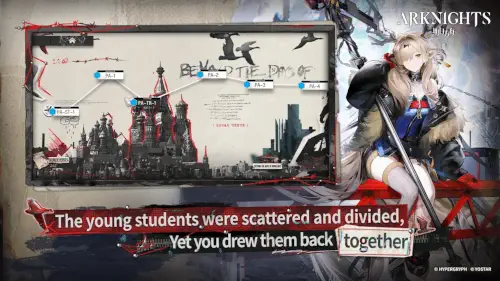
Arknights is a tactical RPG and tower defense game that turns every battle into a problem of positioning, timing and resource management rather than simply asking players to overpower enemies with stronger characters.

Developed by Hypergryph and published globally by Yostar Limited, Arknights game combines anime style character design, serious science fiction and fantasy storytelling, challenging stage mechanics and a character collection system built around Operators. Instead of relying on conventional turn based combat or real time action, Arknights asks you to study the battlefield, understand enemy routes, choose the right Operators and make every deployment count.
That structure is a major reason the game stands apart from many mobile RPGs. The Operators you collect are not simply characters whose statistics determine whether you win. Their classes, skills, attack ranges, blocking abilities, deployment costs and positioning all influence how a stage develops. A lower rarity Operator can remain useful when placed correctly, while an expensive or powerful unit can still fail if deployed at the wrong moment. This gives Arknights tower defense gameplay a tactical layer that rewards understanding the battlefield as much as building a strong roster.
How Arknights Gameplay Works
Arknights gameplay takes the familiar structure of tower defense and turns it into a much deeper tactical RPG system. Instead of building permanent defensive structures and simply watching enemies approach, players deploy Operators onto specific tiles and actively manage their positioning, deployment costs, skills, and timing throughout a stage.
Every map has defined enemy routes and a limited number of positions where Operators can be deployed. Ground based Operators can block enemies and fight them at close range, while ranged Operators can attack from elevated tiles. The objective is not simply to deal as much damage as possible. A successful team needs to control enemy movement, protect vulnerable Operators, maintain healing coverage, generate enough deployment points and respond to the particular mechanics introduced by each stage.
This makes Arknights tower defense gameplay unusually dependent on planning. A powerful Operator cannot compensate for every tactical mistake and a carefully constructed low rarity team can sometimes succeed where a poorly positioned high rarity roster fails.
Deploying Operators on the Battlefield
Deployment is at the heart of every Arknights stage. Operators require Deployment Points or DP, before they can enter the battlefield, while DP regenerates during combat depending on the stage’s mechanics and the Operators being used.
That creates an immediate tactical decision at the beginning of a mission. Deploying an expensive Operator too early can leave the player without enough DP to establish the rest of the formation, while delaying an important Defender or damage dealer can allow enemies to reach the objective.
Positioning is equally important. A Defender may need to occupy a narrow route where several enemies can be blocked, while a Medic can be positioned behind the frontline to keep that Operator alive. A Sniper or Caster might need an elevated tile with the correct attack range, while a Specialist can be positioned specifically to exploit an enemy weakness or alter the flow of combat.
Operators can also be withdrawn and redeployed after the appropriate cooldown. This means deployment is not necessarily a permanent decision. In more demanding stages, knowing when to remove an Operator and bring them back somewhere else can become part of the solution.
Eight Operator Classes
Arknights has eight primary Operator classes, and understanding what each class contributes is essential for building a functional team. The classes are not simply different versions of the same character type. Each one approaches battlefield problems differently.
Vanguard
Vanguards are closely associated with the opening stages of a battle, particularly because of their ability to help generate DP and establish an early defensive formation. They can give a team the resources needed to deploy more expensive Operators later.
A Vanguard can therefore be more important during the opening moments of a difficult stage than its raw damage numbers might suggest. Getting the early deployment sequence right can determine whether the rest of the team has enough time and space to develop.
Guard
Guards are primarily close range combat Operators capable of dealing substantial physical damage. Their subclasses give them different strengths, allowing some Guards to specialize in sustained frontline combat while others are designed for particular enemy types or tactical situations.
A well developed Guard can become a major source of damage while also contributing to frontline control, making Guards particularly valuable when a stage requires both survivability and offensive pressure.
Defender
Defenders provide the durable frontline that keeps enemies from reaching vulnerable Operators. Their ability to block enemies makes them particularly useful at chokepoints where controlling enemy movement is more important than simply dealing damage.
Defenders also demonstrate one of the central ideas behind Arknights team building: survival and damage are connected. A strong damage dealer cannot contribute effectively if enemies are allowed to pass through the formation, while a Defender becomes far more effective when supported by appropriate healing and ranged damage.
Sniper
Snipers specialize in ranged physical attacks and are especially useful when dealing with enemies that cannot be conveniently handled by frontline Operators. Their ability to attack from elevated tiles gives them a valuable position in many formations.
Snipers also help players control enemies before they reach the main defensive line. Choosing the right Sniper and placing them where their attack range covers the relevant route can dramatically change how a stage develops.
Specialist
Specialists are among the most flexible classes in Arknights. Rather than following one universal battlefield role, they include Operators designed around unusual mechanics and highly specific tactical functions.
Depending on the Operator, a Specialist can manipulate enemy positioning, provide crowd control, exploit particular battlefield situations or perform another specialized task that conventional damage dealers cannot replicate. Their usefulness often becomes clearer once players understand exactly what a stage is asking them to solve.
Medic
Medics keep the rest of the formation alive. Their primary purpose is healing, but their importance goes beyond simply restoring HP. Proper Medic placement can determine whether a frontline Operator survives long enough to continue blocking enemies or whether a difficult wave eventually overwhelms the formation.
Healing coverage also has to be considered alongside enemy attack patterns. A Medic positioned too far away may fail to support the required area, while placing one within dangerous enemy range can create another problem that the player must solve.
Caster
Casters provide Arts based ranged damage and are particularly valuable against enemies whose defenses make conventional physical attacks less effective. Their presence gives teams another way to handle enemies with different defensive characteristics.
The distinction between physical and Arts damage means that choosing between a Sniper and Caster is not simply a matter of selecting whichever Operator has higher attack power. Enemy statistics, positioning, attack range, and the timing of incoming waves all influence the correct choice.
Supporter
Supporters provide utility that can change the conditions of a battle rather than simply focusing on raw damage. Depending on the Operator, Supporters can weaken enemies, strengthen allies, provide control effects or contribute other forms of battlefield assistance.
They become especially interesting in stages where straightforward damage is not enough. A Supporter can sometimes turn an otherwise difficult encounter into a manageable one by improving the effectiveness of the rest of the squad.
Skills, Timing and Tactical Decisions
Operator skills are one of the systems that transform Arknights from a conventional tower defense game into a tactical RPG. Skills can provide bursts of damage, healing, crowd control, defensive benefits or other powerful effects, but their value depends heavily on when they are used.
Activating a skill immediately may solve a small problem while leaving the Operator without that ability when a much more dangerous enemy arrives. Saving it too long can produce the opposite result, allowing the battlefield to become difficult to recover.
This makes Arknights skill timing an important part of advanced play. Players gradually learn enemy spawn patterns, identify dangerous waves and recognize the moments when a particular Operator’s ability can have the greatest impact.
The same principle applies to the entire team. A Defender may need to hold a group of enemies while a Caster prepares an area attack. A Medic may need to activate a healing ability just before a heavy attack lands, while another Operator waits for the correct moment to control an enemy. The strongest solutions often come from coordinating several abilities rather than treating each Operator independently.
Story Missions, Events and Challenge Modes
Arknights does not limit its gameplay to the main story campaign. Story chapters provide the foundation for the game’s narrative and introduce new enemies, environments, mechanics and tactical situations as players progress.
Limited time events expand that experience with their own stories, rewards, and gameplay mechanics. Events can also change the way familiar Operators are used by introducing new battlefield rules or enemy behaviors.
Alongside the standard content are challenge focused modes that push players beyond straightforward stage completion. These modes encourage experimentation with different team compositions and force experienced players to understand the game’s mechanics at a deeper level.
That variety is important because Arknights can feel very different depending on whether a player is progressing through story chapters, farming resources, experimenting with an event mechanic or attempting a difficult challenge.
Integrated Strategies and Roguelite Gameplay
Integrated Strategies adds a roguelite style layer to Arknights by changing how players approach team building and progression during a run. Instead of relying exclusively on a fixed squad prepared before entering a stage, the mode introduces a more dynamic structure in which players make decisions throughout their journey.
The result is a different type of strategic challenge. Players have to adapt to the Operators, resources, encounters and situations available during the run rather than assuming that one carefully prepared squad will always be sufficient.
For players who already understand standard Arknights mechanics, Integrated Strategies provides another way to test decision making. It also gives the game additional replay value because the experience can change depending on the choices made during individual runs.
Contingency Contract and High Difficulty Challenges
Contingency Contract represents another side of Arknights: deliberately pushing the tactical system toward extreme difficulty. Rather than simply increasing enemy strength in a straightforward way, high difficulty challenges can require players to work within additional restrictions and carefully consider which weaknesses they are willing to accept.
This turns familiar Operators and stages into new strategic puzzles. A team that performs comfortably under normal conditions may require completely different positioning, skill timing or Operator selection when additional restrictions are introduced.
For experienced players, this is where the depth of the Arknights high difficulty strategy becomes particularly visible. Success depends less on having a universally powerful roster and more on understanding exactly how Operators interact with enemies, terrain, deployment limits, skills and the conditions imposed by the challenge.
Ultimately, Arknights gameplay is built around one central idea: the solution to a stage is rarely just having stronger Operators. Understanding deployment, positioning, class roles, skill timing, enemy behavior and battlefield mechanics is what allows players to turn a difficult map into a solvable tactical puzzle.
Arknights Progression and Base Building
Leveling and Promoting Operators
Arknights progression is built around gradually turning a newly recruited Operator into a dependable part of your roster. Simply obtaining an Operator does not unlock their full potential. Players need to invest experience, LMD, materials, and other resources to increase levels and develop the skills that make each unit effective in specific battlefield situations.
Operator progression also encourages players to think about their roster as a team rather than attempting to maximize every character immediately. Building a balanced selection of Vanguards, Guards, Defenders, Snipers, Casters, Medics, Specialists and Supporters gives players more options when a stage introduces a different enemy composition or tactical requirement.
Elite 1 and Elite 2 Promotions
Promotion is one of the most important milestones in Arknights Operator progression. Operators can advance through Elite 1 and where applicable, Elite 2 promotion stages, gaining stronger statistics and access to additional capabilities.
Elite 1 is an important early investment because it substantially improves an Operator’s effectiveness and can open access to additional skills or features. Elite 2 represents a considerably larger commitment, requiring more resources but giving high value Operators another significant increase in their long term potential.
The system creates a useful progression curve because an Operator does not simply become stronger through repetitive leveling. Reaching the next promotion stage requires players to collect the appropriate materials and decide which characters deserve those resources first.
Skill Upgrades and Mastery
Levels and promotions are only part of developing an Operator. Skills can dramatically change how a character performs during combat, particularly when their abilities are timed around enemy waves or specific battlefield situations.
Skill upgrades improve these abilities, while Skill Mastery provides a deeper endgame investment for Operators that remain important to a player’s regular teams. Mastery can make a meaningful difference in skill duration, damage, cooldowns, or other effects depending on the Operator.
This is why Arknights skill mastery progression is less about upgrading everything equally and more about identifying the abilities that genuinely change how a team handles difficult content.
Operator Modules
Operator Modules provide another layer of late-game progression. They are designed to further develop selected Operators and can improve their performance while reinforcing the particular role or mechanics associated with them.
Modules add another resource decision to the game. Since long term progression materials are not unlimited, players have to consider which Operators they use frequently and which upgrades provide the greatest practical benefit to their teams.
Farming Upgrade Materials
A major part of Arknights material farming involves returning to stages that provide the resources required for leveling, promotion, skills and other upgrades. Different materials come from different sources, so developing an Operator can become a longer process rather than a single upgrade screen.
Events can also become important sources of resources and rewards. Efficient players generally have to consider which materials they need before spending Sanity, especially when several Operators are waiting for the same upgrade resources.
This creates a progression loop where completing stages produces resources, resources strengthen Operators, and stronger Operators allow access to increasingly demanding content.
The Rhodes Island Base (RIIC)
The Rhodes Island Infrastructure system, commonly referred to as RIIC, gives Arknights a separate progression layer outside combat. Instead of simply collecting resources from completed stages, players can develop facilities and assign Operators to specific jobs within the base.
The base includes facilities such as the Trading Post, Manufacturing facilities, and Power Plants. Operators can be assigned according to their base skills, allowing the player to improve production and maintain a steady flow of resources.
Manufacturing, Trading and Resource Production
Manufacturing facilities can produce useful resources, while Trading Posts convert certain resources into LMD and support the game’s wider economy. Power facilities keep the infrastructure operating, making the base itself a small resource management system.
The interesting part is that Operators are not interchangeable workers. Some have particularly useful base skills, so an efficient Arknights RIIC base setup involves considering which Operators should work in which facilities and how their assignments interact with morale and production.
The base therefore becomes valuable even when the player is not actively fighting through stages. A well managed RIIC can continuously contribute to long-term progression and reduce some of the pressure created by material and currency costs.
Auto Deploy and Stage Farming
Once a player successfully completes a stage with a three star result, Auto Deploy can be used to repeat the established battle sequence. This is particularly useful when a player needs to farm the same stage repeatedly for upgrade materials.
Auto Deploy does not remove the strategic importance of the original clear. Players first need to develop a successful deployment sequence and the automated run then reproduces that strategy for future farming.
For players searching for an efficient Arknights Auto Deploy farming strategy, the important distinction is that automation is primarily a tool for repeating a proven solution. It does not replace the planning required to create that solution in the first place.
Sanity and Daily Progression
Sanity functions as Arknights’ primary energy system. Many stages consume Sanity when entered, while the resource gradually regenerates over time. This places a natural limit on how much material farming a player can complete during a given period.
Sanity management therefore becomes part of daily progression. Spending it on the correct stages, taking advantage of event rewards and avoiding unnecessary farming can make a noticeable difference over a longer period.
This also reinforces the game’s marathon style progression. Players are generally encouraged to make steady progress rather than expecting to completely develop a large Operator roster in a single session.
Arknights Gacha and Economy
How Headhunting Works
Headhunting is Arknights’ primary gacha system for recruiting new Operators. Players use the game’s currencies and recruitment resources to attempt to obtain Operators from available pools, with different banners featuring different rate-up characters.
The system is closely connected to roster development because new Operators can introduce entirely new tactical options. However, recruiting a character is only the beginning of the investment. Operators still require levels, promotions, skills and materials before they reach their full potential.
Operator Rarity and 6★ Rates
Operators range from lower rarities through to 6★ characters. Higher rarity Operators generally have greater long term potential and more complex abilities, but Arknights does not make rarity the sole measure of usefulness.
The research provided places the base 6★ rate at 2%, with the rate increasing after 50 unsuccessful pulls. This gives players a defined pity-related mechanic rather than leaving every pull completely independent.
For Arknights 6 star Operator recruitment, however, the practical consideration is not simply obtaining the highest rarity. Players still need to understand how a particular Operator fits into their roster and whether investing resources into that character improves the teams they actually use.
Orundum and Recruitment
Orundum is one of the important currencies associated with Headhunting. Players can accumulate resources through regular gameplay and use them when deciding which banners deserve their pulls.
Because resources for recruitment are limited, banner planning becomes part of the game’s economy. Spending everything immediately can leave fewer resources available when a particularly desirable Operator appears, while saving allows players to make more deliberate decisions about their recruitment priorities.
Soft Pity and Pull Mechanics
The 6★ recruitment system includes a soft pity mechanic. According to the supplied research, the base 6★ probability is 2%, with the chance increasing after 50 consecutive pulls without obtaining a 6★ Operator.
That system does not eliminate randomness, but it gives players a progressively improved chance of reaching a high rarity result as unsuccessful pulls accumulate.
For players managing a limited free to play currency supply, understanding Arknights pity and pull mechanics is therefore important before committing resources to a banner.
Limited and Standard Banners
Arknights uses both standard and limited recruitment banners, giving players different opportunities to target Operators. Rate-up banners can make specific characters more accessible than simply relying on the entire available Operator pool.
Limited banners add another layer of planning because the opportunity to recruit certain characters can be tied to specific periods. This makes saving recruitment resources an important part of long term account management.
Rather than treating every banner as an automatic reason to pull, players can consider which Operators complement their current roster and which future characters are worth saving for.
Duplicate Operators and the Certificate System
Obtaining an Operator that is already part of the roster does not necessarily make the duplicate worthless. Duplicate recruitment contributes to the game’s certificate system, which can provide additional resources and exchange opportunities.
The certificate system gives duplicate Operators a secondary purpose and can help players obtain specific resources or under the appropriate circumstances, target valuable Operators and materials through the relevant exchange systems.
This adds another layer to the gacha economy because an unsuccessful attempt to obtain a new character can still contribute something toward longer-term account progression.
Is Arknights F2P Friendly?
Arknights has several characteristics that make its free to play structure notably different from games where competitive progression depends heavily on acquiring every new character. The game has no PvP system, and the supplied research notes that story content and most events can be cleared with lower rarity Operators when teams are planned effectively.
That does not mean the gacha can simply be ignored. Randomness still affects recruitment, and players who want specific 6★ Operators may need to save resources and accept that a desired character is not guaranteed from every banner attempt.
The difference is that Arknights places substantial emphasis on strategy over raw Operator rarity. Understanding positioning, class roles, enemy behavior, skill timing, and team composition can compensate for not owning every high rarity character.
For a player searching for a F2P friendly tactical gacha game, this is one of the defining characteristics of Arknights. The experience still involves resource management and gacha luck, but progression does not revolve around competing directly against other players.
Why the Lack of PvP Matters
The absence of in-game PvP changes the way the entire progression system feels. There is no opposing player roster that needs to be defeated and no competitive ladder demanding that players continually chase the newest and strongest Operators.
Instead, progression is primarily about overcoming stages, improving teams, completing events, experimenting with different strategies and tackling increasingly demanding challenges.
That makes the relationship between spending and gameplay different from a PvP focused gacha. A player can choose to develop an account at their own pace without having to match another player’s spending or roster simply to remain competitive.
Ultimately, Arknights progression and economy are built around long term planning. Operators need investment, the RIIC base produces valuable resources, Auto Deploy simplifies repeated farming, Sanity limits daily activity and Headhunting introduces controlled randomness into roster collection. The result is a progression system where patience and tactical knowledge remain important even when a player’s roster is not filled with every available 6★ Operator.
Arknights Beginner Tips and Tricks
Starting Arknights can feel overwhelming because the game introduces Operators, classes, skills, materials, the RIIC base, Sanity, Headhunting and several different modes without reducing the strategic depth of its core combat. The good news is that new players do not need a roster full of 6★ Operators to make meaningful progress. Understanding how the systems work and investing resources carefully is much more valuable during the early stages.
Build a Balanced Operator Team
One of the most useful Arknights beginner tips is to avoid building a squad around damage alone. A balanced team should have Operators capable of generating DP, holding enemy routes, dealing physical and Arts damage, attacking from range and keeping the frontline alive.
Vanguards are particularly useful when a stage requires fast DP generation, while Defenders can establish a reliable frontline. Snipers and Casters provide ranged damage and Medics keep the formation functioning when enemy pressure increases. Guards, Specialists, and Supporters then give the team additional ways to handle situations that a basic formation cannot solve.
The exact composition does not need to remain fixed. Arknights is designed around adapting your roster to the battlefield, so a Specialist or Supporter that appears unnecessary on one map can become extremely valuable on another.
Why You Shouldn’t Chase 6★ Operators Immediately
The highest rarity Operators are naturally attractive, but making them the sole focus of early progression can leave a new account with an underdeveloped team. Lower rarity Operators are often considerably cheaper to develop and can perform their roles effectively when properly positioned.
This is particularly important because Arknights rewards tactical decisions rather than simply comparing character rarity. A well built 4★ Operator can contribute to a successful clear while an expensive 6★ Operator can still fail if the team lacks the right supporting roles.
For new players, the more useful goal is to establish a dependable core roster first. Once the account has a functional team and a stable resource economy, high rarity Operators can be developed without sacrificing the rest of the roster.
How to Use Auto Deploy Efficiently
Auto Deploy becomes one of the most useful time saving systems once a stage has been cleared with a three star result. Instead of manually repeating the same battle every time materials are needed, players can use the recorded deployment sequence to farm the stage again.
However, efficient Arknights Auto Deploy farming starts with creating a reliable manual clear. A stage should not be treated as solved simply because it can be completed once. If the original strategy depends on extremely precise timing or circumstances that can change, the automated run may not always behave exactly as expected.
For routine material farming, it is worth developing stable clears that use dependable positioning and skill timings. That turns Auto Deploy into a practical part of the game’s long term progression rather than simply an emergency shortcut.
Optimize the Rhodes Island Base Early
The Rhodes Island base should not be treated as an optional side activity. Its facilities provide resources that support almost every part of Operator progression, making an efficient RIIC setup valuable from the beginning.
Manufacturing facilities can produce resources, while Trading Posts support LMD generation. Operators with useful base skills can improve production, so assigning characters intelligently can make the base considerably more productive.
Learning the fundamentals of Arknights RIIC base optimization early can save resources and improve the account’s economy over time. The goal is not to constantly rebuild the base, but to establish a useful production routine and make sensible Operator assignments.
Save Orundum for Important Banners
Orundum should be treated as a strategic resource rather than something that needs to be spent whenever a new banner appears. Because Headhunting is affected by randomness, spreading resources across every available banner can leave a player without enough currency when a particularly desirable Operator becomes available.
Saving allows players to approach banners with a clearer objective. A new character may fill an important weakness in the roster, complement an existing strategy, or simply be an Operator the player wants because of their design or story.
This makes Arknights Orundum saving tips particularly relevant for free to play players. Instead of trying to collect everything, decide which Operators are genuinely valuable to the account and plan recruitment resources around those priorities.
Learn From Low Rarity Clears and Community Guides
One of the most useful features of the Arknights community is the large number of strategies built around low rarity Operators. These clears demonstrate that difficult stages can often be solved through positioning, timing, and team composition rather than depending exclusively on expensive characters.
Watching or studying a low rarity clear can also teach more than copying a deployment sequence. It can reveal why an Operator is positioned on a particular tile, when a skill is activated, and how the player responds to a specific enemy wave.
For new players searching for Arknights low rarity stage clears, community guides can therefore function as practical lessons in the game’s mechanics. Once the underlying idea is understood, the same tactical principle can often be adapted to a different roster.
Take Advantage of Events and Integrated Strategies
Events should be part of a new player’s progression rather than something to ignore until the main story is finished. Limited time content can introduce different mechanics, provide rewards, and give players opportunities to practice unfamiliar strategies.
Integrated Strategies offers another valuable learning environment because its roguelite structure encourages adaptation. Players make decisions during a run instead of relying entirely on one fixed squad and one predetermined solution.
For players still learning Arknights strategy and team building, these modes can expose weaknesses in a roster while also encouraging experimentation. They provide a useful break from repeating standard farming stages and can help players understand how different Operators interact.
Manage Sanity and Avoid Burnout
Sanity places a natural limit on stage farming, so new players should avoid treating every available point of energy as something that must be spent immediately. Progression in Arknights is deliberately long term and trying to develop every Operator or farm every material at once can quickly become inefficient.
Prioritize the materials needed for Operators you actually intend to use. During events, consider whether available rewards are more valuable than ordinary farming stages, particularly when event bonuses or special resources are involved.
Most importantly, Arknights is not designed around finishing the entire progression system in a few days. Accepting its slower rhythm makes the daily experience considerably easier to manage.
Arknights vs Similar Games
Comparing Arknights with other games is most useful when focusing on what each title actually asks the player to do. Arknights emphasizes tactical positioning and stage planning, while other strategy and gacha games can place more emphasis on turn based combat, squad management, open-world exploration, or real time action.
Arknights vs Reverse: 1999
Arknights vs Reverse: 1999 is largely a comparison between two story focused gacha RPGs with very different combat structures.
Arknights uses tower defense mechanics, requiring players to manage deployment points, positioning, enemy routes, blocking and skill timing. Reverse: 1999 uses turn based card based combat and places greater emphasis on selecting and combining abilities during encounters.
Both games put considerable attention on narrative presentation and character design, but their moment to moment gameplay demands are quite different. Players who enjoy solving battlefield positioning problems will find Arknights more closely aligned with that preference, while players who prefer turn-based decision-making may find Reverse: 1999’s combat structure more familiar.
Arknights vs Girls’ Frontline
Arknights and Girls’ Frontline both combine character collection with tactical gameplay and substantial story content, but their core combat systems take different approaches.
Arknights is built around tower defense, with Operators positioned directly onto battlefield tiles to control enemy movement. Girls’ Frontline focuses more heavily on squad based tactical management and character formations.
The comparison becomes particularly interesting for players attracted to detailed fictional worlds and long term character development. The two games can appeal to similar audiences while providing very different answers to the question of what tactical mobile gameplay should look like.
Arknights vs Tower of Fantasy and Action Gachas
Arknights is fundamentally different from action oriented gacha RPGs such as Tower of Fantasy. Instead of directly controlling a character through an open world or real time combat environment, players in Arknights control the battlefield through Operator deployment and tactical decisions.
The difference is especially clear during difficult encounters. Action gachas often reward reflexes, movement, direct combat execution, and exploration, while Arknights rewards preparation, positioning, enemy knowledge, and timing.
For players searching for a strategy focused alternative to action gacha games, Arknights offers a much more deliberate pace.
Arknights vs Traditional Tower Defense Games
Arknights shares the basic idea of controlling enemy routes with traditional tower defense games, but its Operator system makes the experience substantially more character driven.
Instead of placing generic towers that perform the same function every time, players deploy named Operators with individual classes, skills, statistics and progression paths. Operators can be leveled, promoted, upgraded and incorporated into long term teams.
The result is a hybrid where tower defense provides the battlefield foundation while RPG progression and character collection create a persistent account level layer.
What Makes Arknights Different From Other Strategy Gachas?
The defining difference is the way Arknights connects its gacha system to a tactical battlefield where raw rarity is not the only route to success. Operators matter, but the player still has to understand where they should be deployed, when their skills should activate, which enemies they can handle and how the entire formation works together.
Its lack of in-game PvP also changes the pressure surrounding roster development. Players can focus on story chapters, events, challenge modes, resource farming and personal progression without competing directly against another player’s account.
Add the RIIC base, Auto Deploy, Integrated Strategies, extensive lore, distinctive art direction and long term Operator progression, and Arknights becomes more than a conventional character collection game.
Its appeal comes from the combination of systems: Arknights tower defense strategy, character collection, resource management, challenging stage design and a large science fiction and fantasy universe. That combination is what gives the game its own identity within the wider strategy gacha genre.
Conclusion
Arknights succeeds because its tower defense foundation is not treated as a simple backdrop for character collection. Every stage asks players to make meaningful decisions about deployment, positioning, enemy routes, Operator classes, DP management and skill timing. The result is a tactical RPG where having a strong roster helps, but understanding how to use that roster is often just as important.
The hybrid structure also gives more long term depth than a conventional stage based defense game. Operators can be leveled, promoted, upgraded and equipped with additional progression systems, while new stages and events continually introduce different tactical problems. The game can therefore remain strategically interesting even after players become familiar with its basic rules.
Arknights FAQ
Is Arknights free to play?
Yes, Arknights is free to play with optional in-app purchases and gacha based Headhunting. Players can build teams without directly buying Operators, while story stages and many challenges can be approached through different team compositions and lower rarity Operators.
How does Arknights gacha work?
Arknights uses Headhunting to obtain Operators, with Orundum being one of the important currencies used for pulls. The game features different Operator rarities, limited and standard banners, pity related mechanics and a duplicate system that can provide additional resources when Operators are obtained again.
Where can I find an Arknights download and official game resources?
For an Arknights download, use the official Google Play Store listing or the official Arknights website rather than unofficial APK sources. Players looking for deeper information can also use the Arknights Wiki for Operators, mechanics and lore, while the Arknights Reddit community is useful for player discussions, guides and troubleshooting.
Does Arknights have PvP, guilds or multiplayer battles?
Arknights is primarily a single player tactical experience and does not revolve around traditional PvP or guild competition. Its wider community activity instead comes through events, challenge clears, strategy discussions, fan content, guides and external communities where players exchange team building and stage clear ideas.