
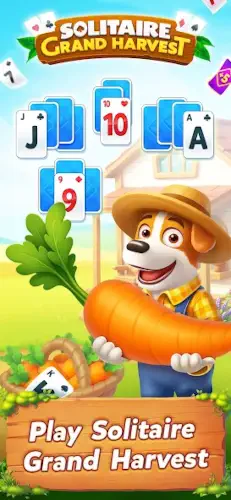
Solitaire Grand Harvest is a free to play TriPeaks solitaire game from Supertreat, a Playtika Studio.

Solitaire Grand Harvest turns a familiar card matching formula into something much bigger: a farm building progression game where every successful solitaire board can feed into your growing virtual homestead. Instead of simply clearing cards and moving to the next deal, you earn coins and crops, unlock new farm areas, collect rewards, and gradually build a personalized farm while progressing through thousands of levels.
What Is Solitaire Grand Harvest?
The Supertreat and Playtika Connection
Solitaire Grand Harvest was developed by Supertreat, a Playtika Studio. That connection is relevant because the game is designed around more than a traditional solitaire session. Its structure combines the card game with persistent progression, rewards, events, resource collection and social systems designed to encourage continued play.
The result is closer to a live mobile game built around solitaire than a simple digital replacement for a physical deck of cards. The TriPeaks board remains the heart of each level, while the surrounding systems provide the longer-term reasons to keep progressing.
The Farm Themed Solitaire Concept
The farm theme gives Solitaire Grand Harvest its clearest identity. Instead of placing the player inside an abstract level map, the game connects solitaire victories with a growing agricultural world filled with crops, livestock, decorations and expandable areas.
This matters because the farm gives players something concrete to work toward. Completing another card board is not only about reaching the next level; it contributes to the resources needed for the next stage of farm development.
That makes the game particularly appealing to players searching for TriPeaks solitaire with farm building, especially those who enjoy casual card games but want a persistent progression system alongside the puzzles.
How Solitaire and Farm Progression Work Together
The two systems operate as a connected loop. You enter a TriPeaks board, clear cards according to the game’s matching rules and receive rewards for your performance. Those rewards can then contribute to farm development, crop collection and other progression activities.
The card game therefore determines the pace of the farm game. Better play can produce stronger streaks and better level results, while resources earned through successful levels help unlock more of the farm.
This connection also gives resource management greater importance. Coins, crops, gems and boosters are not simply numbers attached to the interface. They influence how efficiently you can approach difficult levels and how quickly you can continue developing your farm.
Thousands of Levels and Long Term Progression
Solitaire Grand Harvest is built around a large level progression rather than a short collection of solitaire layouts. The game continually introduces new boards as players move through its map, with difficulty gradually becoming more significant as progression continues.
The sheer number of levels supports the game’s casual-session design. You can play a few boards when you have a spare moment or settle into a longer session focused on extending streaks and earning enough resources to advance your farm.
Three star performance adds another reason to revisit the mechanics. Players can aim for stronger results rather than simply accepting the first successful completion, making efficient card selection and streak management more important for those who want to maximize progression rewards.
Free to Play Structure
Solitaire Grand Harvest is free to start, which means players can experience its core TriPeaks gameplay and farm progression without purchasing the game upfront. Daily bonuses, harvest rewards, social gifts and other free rewards also provide regular opportunities to collect additional resources.
However, the free-to-play structure becomes more noticeable as progression develops. Coins, gems, boosters and other resources influence how players approach difficult boards, while optional purchases can provide additional assistance.
That creates an important distinction between playing Solitaire Grand Harvest for free and playing it without ever interacting with its monetization systems. Free players can progress, but resource management becomes increasingly important if you want to avoid unnecessary spending when levels become more demanding.
Who Is Solitaire Grand Harvest For?
Solitaire Grand Harvest is best suited to players who like the simple rules of TriPeaks but want something more persistent than a conventional solitaire app. Its combination of card puzzles, farm expansion, collectible rewards and daily activities gives each successful board a role within a larger progression loop.
It is particularly well matched to players who enjoy relaxing card sessions but also like having something to build between levels. The farm provides that sense of ownership, while streaks, stars, boosters and events give more competitive or optimization-focused players additional goals.
Players who strongly dislike free to play economies may have a different experience, especially when progression becomes resource intensive. But for someone looking for a casual farm building solitaire game with thousands of levels, Solitaire Grand Harvest offers a focused combination of TriPeaks card strategy and persistent farm progression that gives the familiar solitaire format considerably more personality.
Solitaire Grand Harvest Gameplay
How TriPeaks Solitaire Works
The core of Solitaire Grand Harvest gameplay is its TriPeaks card system, where every level challenges you to clear three pyramid shaped groups of cards using a simple higher or lower matching rule. The rules are easy to understand within minutes, but the board layout creates enough decision making to make later levels considerably more demanding.
The important distinction is that you are not simply matching identical cards. Each move depends on the rank currently available from your play sequence, so choosing the right card can open several more moves and create a much longer streak.
Matching Cards One Rank Higher or Lower
A playable card must be exactly one rank above or below the current card. If the active card is a 7, for example, you can select either a 6 or an 8. Suits and card colors do not determine whether a match is valid, which keeps the focus on sequence planning rather than traditional poker style combinations.
This creates the central tactical question in each board: which available card should you remove first? Taking an immediately playable card may be useful, but choosing another option can sometimes expose several hidden cards and extend the sequence much further.
For players learning Solitaire Grand Harvest TriPeaks strategy, looking beyond the next card is one of the most useful habits to develop. A move that appears equally good on the surface can have a very different effect on the cards underneath it.
Clearing the Three Peaks
Each TriPeaks board contains three pyramid like peaks that must be cleared to complete the level. The exposed cards provide the initial opportunities, while removing them reveals cards underneath and gradually opens deeper sections of the board.
The three peak layout is what gives the game its recognizable solitaire identity. Clearing one area can also influence how you approach another, so efficient play involves considering the entire board rather than treating each peak as an isolated puzzle.
As the level becomes more difficult, the order in which you expose cards becomes increasingly important. Removing the right card at the right moment can create a chain that clears a substantial portion of a peak before you need to draw again.
Drawing From the Deck
When there is no suitable exposed card, you can draw from the remaining deck to continue the level. The deck effectively determines the next available rank and can either rescue a difficult board or bring an otherwise promising streak to an end.
Drawing therefore carries an opportunity cost. If you have several possible moves available, using one without considering what it exposes can leave you dependent on the next deck card sooner than necessary.
For players trying to improve their Solitaire Grand Harvest level strategy, the deck should be treated as a limited resource rather than an automatic solution whenever the board becomes inconvenient.
Playing Only Exposed Cards
Cards covered by other cards cannot be selected until the cards above them have been removed. This is where the board’s layout becomes strategically important.
A move that uncovers multiple cards can be considerably more valuable than one that removes a card without opening anything underneath. When two playable cards are available, examining what each one reveals can determine whether the current sequence continues or quickly collapses.
That simple rule creates much of the game’s puzzle depth. You are constantly balancing an immediate match against the possibility of opening a better sequence several moves later.
Building Longer Card Streaks
One of the most rewarding parts of Solitaire Grand Harvest gameplay is building consecutive card matches without breaking the sequence. Longer runs are not merely satisfying visually; they also feed into the game’s streak and reward systems.
A strong streak can turn a series of ordinary card selections into a much more productive level, making efficient sequencing one of the most valuable skills to develop.
Combo Chains
A combo begins when you successfully continue matching cards without unnecessarily returning to the deck. Each additional playable card keeps the sequence alive and increases the value of maintaining the chain.
The best combo opportunities often appear when you plan several moves ahead. Instead of immediately selecting the first legal card, you can compare the available options and choose the one that is most likely to uncover another playable card.
That makes longer chains feel less like random luck and more like a reward for reading the board correctly.
Streak Meter
The streak meter provides a visual indication that your consecutive moves are building toward additional rewards. As cards are successfully played in succession, the meter progresses, reinforcing the value of maintaining momentum.
The system is particularly useful for new players because it makes the consequences of uninterrupted play immediately visible. Once you understand that breaking a sequence can reduce your potential rewards, card selection becomes more deliberate.
Maintaining a Winning Streak
Maintaining a strong streak requires patience. The safest move is not always the most profitable move, particularly when several exposed cards are available.
Experienced players can examine what sits underneath each possible choice and prioritize moves that reveal more playable cards. This approach increases the chance of continuing the chain while also helping clear larger sections of the board before relying on the deck.
The result is a satisfying balance between immediate matching and short-term planning, especially on levels where a single poor choice can end a promising run.
Star Ratings and Level Performance
Completing a level is only one measure of success in Solitaire Grand Harvest. The game also evaluates performance through a one to three star system, giving players a reason to improve a board they have already completed.
Stars add another layer to the normal win-or-lose structure. Instead of simply asking whether you cleared the cards, the game encourages you to ask how efficiently you cleared them.
One Star to Three Star Results
Players can earn between one and three stars depending on their performance. Using fewer moves and finishing with more cards remaining contributes toward a stronger result.
A one star completion still advances your progress, but achieving three stars becomes a separate optimization challenge. It encourages you to refine your card choices rather than simply accepting the first successful clear.
For players interested in how to get three stars in Solitaire Grand Harvest, the key is not rushing through available matches. Preserving a strong sequence and uncovering useful cards can make a significant difference to the final rating.
Why Three Stars Matter
Three-star results have value beyond the satisfaction of achieving a perfect-looking level. Consistently earning stronger ratings can contribute to additional reward opportunities and makes the overall progression more efficient.
The three-star target also changes how experienced players approach familiar boards. A level that was previously considered complete can become a puzzle to optimize, with players searching for a cleaner sequence and fewer unnecessary deck draws.
Diamond Crate Rewards
Three star performance becomes particularly attractive because completing the required three star progress can contribute toward Diamond Crate rewards at the end of a crop.
This gives the star system a direct connection to the wider economy. Improving your card-play efficiency can therefore lead to rewards that extend beyond the individual level.
For resource conscious players, this makes three star hunting a practical part of Solitaire Grand Harvest reward strategy, rather than simply an optional achievement.
What Happens When You Run Out of Moves?
Not every TriPeaks board will unfold in your favor. A sequence can eventually reach a point where no suitable exposed card remains and the available deck cannot provide enough useful matches to finish the board.
At that point, the decision becomes less about card matching and more about resource management. You can restart, use an available booster or consider whether spending additional resources is actually worthwhile.
Restarting a Difficult Level
Restarting can be the sensible option when a board has become unfavorable and finishing it would require disproportionate spending. This is particularly relevant when you still have many cards left and the cost of rescuing the level outweighs the value of continuing.
A failed attempt does not necessarily mean the level is impossible. A different opening sequence can expose a better arrangement of cards and create a substantially longer streak on the next attempt.
Using Boosters to Finish a Board
Boosters provide another way to recover when a level becomes difficult. Special tools and cards can give you additional flexibility, clear playable cards or create opportunities that would not otherwise exist.
However, boosters are valuable resources rather than something to activate automatically. Saving powerful items for genuinely difficult boards can prevent you from exhausting your inventory on levels that could have been completed through better sequencing.
Managing Risk Before Spending Resources
Resource management becomes increasingly important when levels become harder. Before spending coins, gems or a powerful booster, it is worth considering how many cards remain, whether another draw could realistically solve the board and what the reward for completion will be.
This creates a useful risk-versus-reward decision at the end of difficult levels. Solitaire Grand Harvest is at its most strategically interesting when the player has to decide whether to rescue a promising board or walk away and try again without wasting valuable resources.
Solitaire Grand Harvest Farm Building
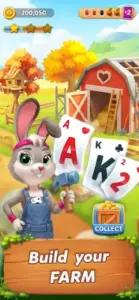
The card boards provide the moment-to-moment challenge, but the Solitaire Grand Harvest farm-building system gives those victories a persistent purpose. Instead of ending when the final card disappears, successful solitaire play feeds resources into a growing farm that can be expanded, decorated and developed over time.
This is the feature that most clearly separates Solitaire Grand Harvest from a traditional TriPeaks app. The farm creates a second progression track that gives players something tangible to work toward between card levels.
Turning Solitaire Wins Into Farm Progress
Every successful level contributes to the broader progression loop through rewards such as coins and crops. Those resources can then be used to advance your farm, making the card game and farm system closely connected rather than completely separate activities.
Earning Coins and Crops
Coins are one of the key resources generated through solitaire progression, while crops form another important part of the farm economy. Harvesting crops can provide additional credits throughout the day, creating another reason to return to the farm after completing card levels.
This creates a simple but effective cycle: clear cards, collect resources, harvest the farm and reinvest those rewards into further progression.
Expanding New Farm Areas
As you progress through levels, new areas of the farm become available. Expansion gives the long-term progression a visual sense of movement because the farm gradually develops alongside your advancement through the solitaire map.
Instead of seeing progress only as a changing level number, players can watch their virtual property grow as they continue completing TriPeaks boards.
Planting and Harvesting Crops
Crop production gives the farm a more active role in the economy. Players can plant and harvest crops, with those activities feeding additional rewards into the wider progression system.
The crop mechanic also helps break up repeated card sessions. After several TriPeaks boards, returning to the farm provides a different interaction while still contributing to the same overall progression loop.
Farm Customization
Farm development is not limited to unlocking functional areas. Players can also shape the appearance of their personal farm through decorations and other customization options.
This gives the progression system a personal element. Two players can move through the same solitaire levels while developing farms that look different depending on how they choose to spend their resources.
Buying Decorations
Coins and other earned resources can be invested in decorations that change the appearance of the farm. These purchases provide a visual reward for continued solitaire progress rather than simply increasing an invisible statistic.
For players who enjoy customization, decorating becomes another reason to keep clearing boards after the novelty of the basic card mechanics has worn off.
Designing Your Personal Farm
The personal-farm concept makes the game feel more persistent than a conventional solitaire collection. The farm becomes a visual record of your progress, with new areas, crops and decorations gradually transforming the environment.
That is particularly effective for casual players who prefer games where progress is easy to see. Completing another level has a direct connection to the evolving space you have been building.
Unlocking New Farm Content
Farm content becomes available progressively as players advance through the game’s level map. This creates a steady sequence of goals in which completing more solitaire boards opens additional opportunities for farm development.
The result is a progression system that constantly links the next card level with something beyond the card board itself.
Livestock and the Farm World
The farm is populated not only by crops and decorations but also by virtual livestock and other elements associated with the game’s agricultural setting. These details reinforce the idea that the player is developing a living farm rather than simply decorating a static menu screen.
The tranquil farm environment also provides a visual contrast to the concentration required during difficult TriPeaks boards. After a challenging sequence of card decisions, returning to the farm gives the game a noticeably more relaxed rhythm.
Why the Farm Meta Game Keeps Solitaire Interesting
The farm meta game is arguably the biggest reason Solitaire Grand Harvest can sustain longer-term interest. Traditional solitaire can be highly replayable, but its reward is often limited to completing another deal. Here, every successful board contributes toward a larger project.
That connection gives casual victories more weight. Clearing a difficult TriPeaks level can mean new resources, another crop harvest, a farm expansion or another decoration rather than simply a higher level number.
For players searching for a farm building solitaire game with TriPeaks levels, this is the central appeal of Solitaire Grand Harvest. The card mechanics provide the challenge, while the farm supplies the persistent sense of ownership and progression that keeps those individual victories connected.
Solitaire Grand Harvest Coins, Gems, Crops and Resources
Coins
Coins are the everyday currency that keeps the Solitaire Grand Harvest progression system moving. They connect successful TriPeaks levels with the wider farm economy, allowing players to turn card game victories into resources they can use across the game.
How Coins Are Earned
The most consistent way to build a coin balance is by completing solitaire levels. Successful boards provide coin rewards, while additional opportunities can come from harvests, daily bonuses, events and other reward systems.
That makes efficient card play especially valuable. A player who regularly completes levels, maintains longer streaks and takes advantage of available free rewards can build resources without relying entirely on purchases.
For players looking for how to earn more coins in Solitaire Grand Harvest, the important point is that coins come from several connected systems rather than one single source.
Where Coins Are Spent
Coins can support both solitaire progression and farm development. Players can use their resources to advance the farm, purchase decorations and access gameplay-related benefits depending on the available systems and events.
The temptation is to spend whenever a new option appears, but keeping a reserve is usually more useful when approaching difficult levels or limited-time events. A healthy coin balance gives you more flexibility when a board does not go according to plan.
Gems and Premium Resources
Gems occupy a more valuable position in the game’s economy. Unlike ordinary coins, premium resources can be particularly important when players need additional assistance during challenging levels.
Using Gems for Boosters and Special Items
Gems can be used toward boosters and special gameplay items, making them useful when a difficult board threatens a valuable streak or a strong three star result.
The best use of premium resources depends on the situation. Spending gems simply because a level is inconvenient can quickly drain your balance, while using them when a small intervention can secure a meaningful reward is easier to justify.
For free to play players, Solitaire Grand Harvest gem management is therefore less about spending frequently and more about recognizing when a premium resource actually changes the outcome.
Crops and Harvest Rewards
Crops are one of the features that make the farm economy feel connected to the solitaire gameplay rather than functioning as a separate decorative system.
Collecting Crops Throughout the Day
As crops become available, players can return to the farm and collect their harvest for additional rewards. This gives the game a reason to check in throughout the day even when you are not actively trying to push through another long sequence of solitaire levels.
The harvest loop also fits naturally into the game’s casual structure. A short visit can produce useful resources without requiring another extended play session.
Turning Farm Progress Into More Rewards
The farm is effectively another source of progression. Crops and farm development can generate additional credits and contribute to the resources needed for continued advancement.
This creates a circular economy where solitaire generates resources for the farm, while the farm provides additional rewards that help support future solitaire sessions.
Credits and Other In-Game Resources
Credits and related resources add further layers to the game’s economy. They can be used for power-ups, farm items and other progression-related opportunities depending on the feature or event currently available.
Because different resources serve different purposes, treating every reward as interchangeable is a mistake. Keeping track of what each currency can actually unlock makes it easier to avoid wasting valuable resources on low-impact purchases.
Diamond Crate Rewards
The Diamond Crate gives three-star performance an additional purpose. Players who consistently achieve strong level results can work toward Diamond Crate rewards at the end of a crop.
This makes star optimization more meaningful than a simple score-chasing exercise. A cleaner card sequence can ultimately improve the rewards flowing into your broader progression.
For players focused on Solitaire Grand Harvest three star strategy, the Diamond Crate is one of the clearest reasons to improve how efficiently each board is played.
Smart Resource Management
The strongest resource strategy is not simply collecting as much as possible; it is deciding when each resource creates the most value. Coins, gems, boosters and farm rewards all have different roles, and spending them impulsively can make later progression harder.
A practical approach is to protect premium resources, use ordinary coins carefully and take advantage of free daily and event rewards before spending anything. Difficult levels should receive more attention than easy boards, particularly when a booster can make the difference between a productive run and a failed attempt.
For free to play players, this careful approach can make Solitaire Grand Harvest resource management far more sustainable over a long progression run.
Solitaire Grand Harvest Power-Ups and Special Cards
Power-ups and special cards add another tactical layer to the basic TriPeaks rules. Instead of relying exclusively on the cards dealt to the board, players can use special effects to recover difficult positions, extend opportunities or clear multiple cards.
The important part is knowing that a powerful item is not automatically valuable on every level. Timing often matters more than raw strength.
Wild Cards
Wild Cards provide flexibility by allowing players to match cards regardless of the normal rank requirement. They can be particularly useful when a promising sequence is about to break because no conventional match is available.
Saving a Wild Card for a critical point can preserve a long streak and potentially expose another section of the board.
Windmill Cards
Windmill Cards introduce another special effect into the solitaire board and can help players deal with situations where ordinary card sequencing becomes restrictive.
Their value is highest when their effect opens additional possibilities rather than simply being used because it is available.
Clear Playable Cards
The Clear Playable Cards power-up can remove all currently playable cards from the board. This can create a major opening when multiple exposed cards are available and the normal sequence would otherwise require several individual moves.
Used at the right moment, it can transform a congested board into a much more manageable one.
Wild Drop
Wild Drop adds Wild Cards to the board, creating additional opportunities to continue a sequence.
Its value becomes especially noticeable when the current deck and exposed cards leave few natural matches. Rather than abandoning a promising run, a Wild Drop can give the board another route forward.
Plus Cards
Plus Cards provide additional cards or moves, giving players extra room to continue a difficult level.
They are particularly useful when the board is close to completion but the remaining deck does not offer enough opportunities to finish naturally.
Double Cards
Double Cards increase the potential value or effect of a move, making them more attractive when the resulting reward justifies their use.
Using one early on a low-value situation can reduce its overall impact. Waiting for a board where the enhanced reward or effect matters more can produce a better return.
Bombs
Bombs can clear multiple cards at once, making them one of the more direct answers to crowded or difficult boards.
They are especially useful when several cards are preventing access to important sections of a peak. Rather than spending multiple moves on individual cards, the Bomb can create a much larger opening.
When to Use Boosters
Knowing when to use boosters in Solitaire Grand Harvest can be more important than collecting them. Every power-up has an opportunity cost, so the best players treat their inventory as a reserve for situations where normal card sequencing is unlikely to succeed.
Saving Boosters for Difficult Levels
Powerful boosters are generally more valuable on levels where the normal route to completion is genuinely difficult. Saving them for these situations ensures that your inventory remains useful when the difficulty rises.
A booster that rescues a board with only a few cards remaining may be valuable, but using the same item on an easy level provides much less benefit.
Avoiding Waste on Easy Boards
Easy boards usually offer enough natural matches to complete without assistance. Using a Wild Card or Bomb simply to speed up an uncomplicated level can leave you with fewer resources when a genuinely difficult board appears.
This is particularly important for players following a free to play approach, where rebuilding a booster inventory can take longer.
Choosing Boosters Based on the Board
Different board problems call for different solutions. A Wild Card is useful when the sequence is about to break, while a Bomb can be more effective when multiple cards need to be cleared. Extra moves become more valuable when the board is nearly solved but the available deck is running out.
The strongest Solitaire Grand Harvest booster strategy therefore starts with reading the board and identifying the actual problem before selecting an item.
Solitaire Grand Harvest Daily Bonuses and Rewards
Daily rewards give Solitaire Grand Harvest a strong check-in loop beyond its standard level progression. Players who return regularly can collect free resources, harvest rewards and bonus opportunities that gradually add up over time.
These systems are particularly useful for players who want to progress without constantly purchasing additional resources.
Daily Login Bonuses
Daily login rewards provide a straightforward reason to open the game even when you only have a few minutes available. Consistent check-ins can produce free resources that would otherwise need to be earned through additional levels or purchases.
For casual players, these small rewards can become surprisingly valuable over weeks of regular play.
Harvest Rewards
Harvest rewards connect daily activity directly to the farm. Returning to collect available crops can provide additional credits and keep the agricultural side of the game moving.
The mechanic encourages a simple routine: play when you want, check the farm regularly and collect what has become available.
Spin the Wheel
The Spin the Wheel feature provides another opportunity to receive free rewards. Depending on the available reward pool, spins can provide useful resources, boosters, gems or other gameplay items.
Because the feature is based around a limited bonus opportunity, remembering to use available spins can improve the value of regular check-ins.
Find Sam
Find Sam adds a small discovery element to the daily reward structure. Finding the companion can provide additional credits and surprises, giving players another reason to check the game’s available daily activities.
It is a minor feature compared with the main solitaire loop, but these small reward sources become more significant when combined with login bonuses, harvesting and missions.
Daily Missions
Daily missions give players specific short-term objectives to complete for additional rewards. Instead of simply playing levels without a secondary target, missions can influence what you choose to do during a session.
This makes daily play feel more purposeful and provides another path toward building your resource balance.
Free Rewards for Consistent Players
The biggest advantage of the daily systems is their cumulative effect. A single login reward may not transform your progression, but combining daily bonuses, crop harvesting, wheel spins and missions can produce a steady stream of free resources.
That is especially important for players trying to enjoy Solitaire Grand Harvest without spending money, because consistent activity can offset some of the pressure created by difficult levels and resource costs.
How Daily Rewards Affect Progression
Daily rewards effectively smooth out the game’s resource economy. Even if a player has a poor solitaire session, the daily systems provide additional opportunities to recover some resources.
Over time, this makes consistency more valuable than occasional marathon sessions. A player who checks the game regularly can accumulate bonuses while continuing to progress naturally through the TriPeaks levels.
Solitaire Grand Harvest Events and Challenges
Events and challenges add temporary goals to the normal progression loop, often providing rewards that are more attractive than those available from ordinary levels.
They also change the rhythm of the game. Instead of always chasing the next level, players can temporarily focus on an event objective and adjust how they spend their saved resources.
Regular In-Game Events
Regular events give players additional reasons to return beyond their normal level progression. Event objectives can introduce different reward opportunities and encourage players to participate during a specific period.
For experienced players, events are also an opportunity to turn saved boosters and resources into a stronger overall return.
Daily Challenges
Daily challenges provide smaller, repeatable objectives that fit naturally into short play sessions. They can reward players for completing particular activities and give the day’s gameplay a more defined purpose.
This is particularly useful for casual players who do not want to commit to lengthy sessions but still want meaningful daily progression.
Seasonal Content
Seasonal content keeps the game from feeling completely static. Limited time themes, challenges and rewards can change what players have to pursue during a particular period.
The temporary nature of seasonal content also creates urgency. Missing an event may mean missing rewards that are not available through ordinary level progression.
Higher Event Rewards
One of the strongest reasons to participate in events is the potential for improved rewards. Events can provide additional resources, collectibles, boosters and other incentives that make participation worthwhile.
For players who carefully manage their resources, these rewards can accelerate progression without requiring additional spending.
Special Offers and Collectible Rewards
Special offers and collectible rewards can appear alongside limited-time activities, giving players additional opportunities to expand their inventories or farm progression.
However, not every offer represents equal value. Players should compare the actual reward with the resources required rather than treating every limited-time promotion as something that must be purchased.
Saving Coins and Boosters for Events
Resource preparation can make a significant difference during event periods. Instead of spending every coin and booster immediately after earning it, keeping a reserve allows you to take advantage of event objectives when they provide better rewards.
A player who enters an event with a healthy resource balance has more flexibility to chase higher value milestones without disrupting normal progression.
For Solitaire Grand Harvest event strategy, this is one of the most useful long-term habits: build resources during ordinary play, then deploy them when an event offers a compelling return.
Why Events Matter for Long Term Progression
Events prevent the game’s progression from becoming a simple straight line of level after level. They introduce temporary objectives, new reward opportunities and reasons to revisit familiar mechanics.
Combined with daily bonuses, farm development and thousands of TriPeaks levels, events create a more layered progression loop. For players who enjoy maximizing rewards rather than simply completing boards, they become an important part of the Solitaire Grand Harvest long term progression strategy.
Solitaire Grand Harvest Tips and Tricks
Beginner Tips for New Players
Starting Solitaire Grand Harvest is easy because the basic TriPeaks rules are familiar, but progressing efficiently requires more than simply tapping the next available card. Early habits can determine how quickly you build coins, earn stars, collect crops and unlock new areas of the farm.
Learn the TriPeaks Matching Rule
The foundation of every level is simple: play an exposed card that is exactly one rank higher or lower than the current card. A 7 can follow a 6 or 8, regardless of suit or color.
Understanding this rule is only the beginning. The real advantage comes from recognizing which available card creates the best sequence and which move exposes more of the board.
Focus on Longer Card Chains
Longer chains are one of the most valuable skills to develop because consecutive matches build the streak system and can increase your rewards. Instead of immediately choosing any playable card, look at the cards underneath and consider which option gives you the greatest chance of continuing.
A strong chain can clear a surprising portion of a TriPeaks board before you need to draw again.
Aim for Three Stars
Three-star results are worth pursuing because they can contribute toward Diamond Crate rewards and reflect efficient level completion.
Rather than treating stars as a cosmetic score, think of them as another progression target. Fewer unnecessary moves and better card sequencing can improve your result while helping you preserve resources.
Use Free Daily Rewards
Daily bonuses are among the easiest resources to overlook. Login rewards, spins, missions and other free opportunities can gradually build your supply of coins, boosters and other useful items.
For anyone searching for Solitaire Grand Harvest free rewards, consistency matters more than trying to collect everything during one long session.
Collect Harvest Rewards
The farm is not just decoration. Returning to collect available crops gives you another source of resources and keeps the farm economy active.
Make harvesting part of your regular routine, particularly if you are trying to progress without spending heavily.
Connect With Friends
Friend connections can provide free gifts such as coins, boosters and other goodies. The social system therefore has a practical impact on progression rather than existing purely for interaction.
Building a useful friend network can give free to play players another way to supplement their normal level rewards.
Play at Lower Fees
Playing at lower fees can help protect your coin balance, especially when you are still learning how difficult boards behave. Choosing a lower-cost option most of the time reduces the amount you risk when a level goes badly.
This is particularly important when your priority is long term progression rather than rushing through levels.
Save Boosters for Hard Levels
Boosters should be treated as a reserve rather than something to activate whenever a board becomes slightly inconvenient.
Easy levels usually provide enough natural card sequences to finish without assistance. Save your strongest power-ups for boards where they can prevent a likely failure or protect a valuable three-star opportunity.
Advanced Solitaire Grand Harvest Strategy
Once the basic TriPeaks mechanics become second nature, the biggest improvement comes from reading the board before making each move. Solitaire Grand Harvest strategy becomes less about finding a playable card and more about finding the playable card that creates the strongest future position.
Prioritize Cards That Reveal More Cards
When two cards are both playable, favor the one that exposes more hidden cards whenever the surrounding layout supports that choice.
Removing one card can sometimes reveal several new cards, creating a chain reaction that is far more valuable than simply taking the easiest available match.
This is one of the most reliable ways to improve your Solitaire Grand Harvest level strategy.
Look for Multiple Follow-Up Moves
Before committing to a card, check whether it leaves another playable card immediately afterward. A move that looks attractive on its own may actually terminate your streak, while another option can open two or three additional moves.
The best sequences are often visible one or two cards ahead if you slow down before tapping.
Plan Several Moves Ahead
Strong players do not only react to the current deck card. They examine the exposed layout, consider what will become available and choose a route that keeps multiple options open.
This is especially important when clearing the three peaks because one poorly chosen card can remove the option needed to access another section of the board.
Manage Your Coin Balance
Coins determine how much room you have to absorb failed attempts and continue progressing. Spending aggressively on every difficult level can leave you unable to take advantage of better opportunities later.
Keep a reserve and consider the expected value of each attempt before committing a large amount of currency.
Know When to Restart a Level
Not every failed board deserves a rescue attempt. If you are left with several cards and the remaining sequence looks unlikely to succeed, restarting can sometimes be more economical than repeatedly spending resources to force a win.
This is particularly useful for players following a free to play Solitaire Grand Harvest strategy, where conserving coins and boosters matters more than completing every board at any cost.
Save Resources for Events
Events can provide better reward opportunities than ordinary progression, so spending your entire inventory immediately can work against you.
Build a reserve of coins and boosters during normal play, then use them strategically when an event provides a worthwhile reward path.
Maximize Three Star Opportunities
Three-star performance should be considered alongside level completion. If the board offers a realistic opportunity to finish efficiently, think about preserving cards and minimizing unnecessary moves rather than rushing toward the first possible clear.
The extra effort can contribute toward Diamond Crate rewards and make your overall progression more efficient.
Optimize Farm Progression
Do not treat farm development as something completely separate from solitaire. Coins, crops and farm expansion form part of the same progression loop.
Keeping the farm moving while continuing to improve your solitaire performance creates a stronger resource cycle and gives your accumulated rewards somewhere meaningful to go.
What Players Like About Solitaire Grand Harvest
Relaxing TriPeaks Solitaire Gameplay
The core appeal is the combination of simple rules and surprisingly strategic card sequencing. Players can understand the basic mechanics quickly, while longer streaks and increasingly difficult layouts give experienced players something to optimize.
That makes the game suitable for short sessions but also capable of supporting much longer progression runs.
Farm Building Adds More Than Traditional Solitaire
The farm changes what happens after a solitaire victory. Instead of simply moving from one card board to another, players can use their rewards to expand and customize a growing virtual farm.
This creates a second progression layer that traditional solitaire games do not normally provide.
Thousands of Levels
The large level count gives the game substantial longevity. Players who enjoy the basic TriPeaks loop have a long progression path rather than a short collection of puzzles.
The gradual increase in challenge also means the game can evolve from casual card matching into more deliberate resource and streak management.
Daily Bonuses and Harvest Rewards
Daily rewards give players a reason to return even when they do not have time for a long session. Login bonuses, harvests, spins and missions can provide useful resources with relatively little effort.
For casual players, this recurring reward loop is one of the game’s most convenient features.
Special Cards and Boosters
Wild Cards, Windmill Cards, Wild Drop, Bombs, Plus Cards and other power-ups give players ways to deal with difficult boards.
They also add decision-making beyond the standard one-rank-higher-or-lower rule because the question becomes not only whether a booster works, but when using it produces the greatest advantage.
Win Streaks and Combo Rewards
The streak system rewards players who can maintain consecutive card matches. Longer sequences make the basic TriPeaks mechanic feel more dynamic and encourage players to look beyond the immediate move.
This gives skilled card sequencing a tangible reward rather than making every successful match equally valuable.
Colorful Farm Themed Graphics
The farm presentation gives the game a distinctive visual identity. Bright landscapes, crops, animals and decorations provide a much warmer atmosphere than a traditional solitaire interface.
The contrast between clean card layouts and colorful farm environments also helps separate the two sides of the progression loop.
Social Gifting
Friend gifting adds a practical social layer through free coins, boosters and other goodies. Players can benefit from connecting with others rather than simply competing against a leaderboard.
For resource conscious players, these gifts can become a useful supplement to ordinary rewards.
Offline Play
Offline support makes the game convenient for situations where an internet connection is unavailable. Players can continue enjoying solitaire without requiring constant connectivity, with progress designed to transition back when they reconnect.
That makes the game particularly appealing for casual sessions while traveling or away from reliable internet access.
Events and Seasonal Content
Regular events and seasonal activities give players additional objectives beyond simply completing the next level. Temporary rewards can also change how players approach their stored coins and boosters.
For long-term players, these events help prevent the progression loop from becoming completely repetitive.
High Replayability
The combination of thousands of boards, streaks, stars, farm development, events, daily rewards and boosters gives players several reasons to keep returning.
Even when the underlying TriPeaks rule remains familiar, the surrounding progression systems continually provide another target to work toward.
Free to Play Accessibility
The game can be started and played without requiring an upfront purchase. Optional purchases exist, but players can also build resources through normal gameplay, daily rewards, harvesting, social gifts and events.
The free to play structure is therefore accessible, although managing resources becomes increasingly important for players who choose not to spend.
Common Criticisms of Solitaire Grand Harvest
In-App Purchase Pressure
The biggest concern for some players is the relationship between difficulty, resources and purchases. When a difficult board consumes coins or requires additional assistance, the availability of paid resources can make the monetization feel more noticeable.
This does not prevent free play, but it can influence how comfortable the progression feels for players who prefer not to spend.
Pay to Win Concerns
Some players perceive the ability to purchase additional resources and boosters as creating an advantage over players who rely exclusively on normal progression.
For a primarily casual solitaire game, this matters less than it would in a competitive multiplayer title, but it can still affect how players perceive difficult levels and event progression.
Difficulty Spikes
The game’s increasing challenge can occasionally feel abrupt. A player may move comfortably through several boards before encountering a level where the available sequence becomes much less forgiving.
When that happens, boosters or additional attempts can become more tempting, which makes difficulty management an important part of the experience.
Resource Management Pressure
Coins, gems, boosters and other resources can disappear quickly when several difficult levels arrive together.
Players who do not pay attention to their balances may find themselves with fewer options precisely when they need them most. This makes careful spending particularly important for free-to-play users.
Event Spending Pressure
Limited-time events can create a sense of urgency because their rewards are available for a restricted period. Players who want to maximize event rewards may feel encouraged to spend resources or participate more aggressively.
The event structure is most enjoyable when treated as an optional opportunity rather than something that must be completed at any cost.
Grind Heavy Progression
The large number of levels is a strength for players who enjoy long-term progression, but it can also feel repetitive for anyone who wants constant mechanical variety.
The basic TriPeaks formula remains at the center of the game, so players who become tired of card matching may eventually find the progression grind more noticeable.
Losing Coins on Difficult Levels
Failed attempts can make difficult levels especially frustrating because the setback is not limited to time. Losing coins while failing to complete a board can reduce the resources available for subsequent attempts.
This creates an important strategic question: when should you keep trying, and when is it better to stop before the cost becomes too high?
The Balance Between Free and Paid Progression
Solitaire Grand Harvest works best when players understand that free progression requires patience and resource discipline. The game provides multiple free reward sources, but optional purchases can make progression faster or provide additional assistance.
The experience can therefore feel very different depending on whether the player prioritizes relaxed progression, aggressive level advancement or maximum event rewards.
Who May Find the Monetization Frustrating?
Players who want a completely unrestricted solitaire experience may be the most likely to dislike the monetization model. Someone who prefers to play at their own pace, collect daily rewards and accept occasional difficult levels may find the system easier to tolerate.
The bigger issue arises when players feel compelled to spend to overcome a board, maintain a streak or compete for limited time rewards. For those players, Solitaire Grand Harvest free to play progression may feel considerably more restrictive than the relaxing presentation initially suggests.
Solitaire Grand Harvest User Reviews
What Players Commonly Praise
Players frequently describe Solitaire Grand Harvest as relaxing, easy to understand and surprisingly addictive once the card streak system becomes familiar. The farm provides an additional reason to continue playing after a successful board, while colorful visuals make the experience feel less like a traditional card game.
The combination of solitaire levels, crops, decorations, daily rewards and thousands of boards is particularly appealing to players looking for a farm themed TriPeaks solitaire game for mobile rather than a basic classic solitaire app.
What Players Commonly Criticize
The strongest criticism concerns the game’s monetization. Some players feel that difficult boards can consume coins too quickly and that certain situations make boosters or purchases feel increasingly attractive.
Other complaints focus on difficulty spikes, event pressure and the amount of grinding required to maintain progression without spending. These criticisms do not erase the game’s strong overall rating, but they are important for anyone approaching the game as a strictly free-to-play experience.
Solitaire Grand Harvest Compared With Similar Games
Solitaire Grand Harvest vs Solitaire TriPeaks
TriPeaks Card Gameplay
Both games are built around the recognizable TriPeaks format, where exposed cards are removed by playing a card one rank higher or lower than the current card.
Solitaire Grand Harvest adds substantially more progression around that core mechanic, turning individual boards into part of a broader mobile-game economy.
Farm Building Meta Game
This is the biggest distinction. Solitaire Grand Harvest connects card victories to crops, coins, farm expansion and decoration.
A more traditional Solitaire TriPeaks experience keeps the focus primarily on clearing card layouts rather than developing a persistent farm.
Progression Differences
Solitaire Grand Harvest is designed around long-term progression through thousands of levels and a growing farm. Players therefore have more reasons to keep returning after mastering the basic card rules.
Solitaire Grand Harvest vs Solitaire Wonder Island
TriPeaks Mechanics
Both titles use TriPeaks style solitaire as the foundation, so players familiar with one can understand the basic card interaction quickly.
The difference becomes more obvious once the meta game enters the picture.
Meta Game Progression
Both games place a progression layer around solitaire rather than treating every board as an isolated puzzle.
Solitaire Grand Harvest’s identity comes specifically from linking those card victories to farm development and harvest rewards.
Farm Versus Island Building
The settings create different motivations for progression. Solitaire Wonder Island uses an island-building concept, while Solitaire Grand Harvest makes crops, farming and rural customization central to its presentation.
Solitaire Grand Harvest vs Solitaire by MobilityWare
Classic Solitaire Versus TriPeaks
This is a more fundamental mechanical difference. MobilityWare’s Solitaire is associated with traditional solitaire formats, while Solitaire Grand Harvest centers its experience around TriPeaks card clearing.
Players looking for familiar Klondike-style solitaire may prefer the former, while those wanting TriPeaks solitaire with farm progression will find Solitaire Grand Harvest more relevant.
Daily Challenges
Daily challenges and recurring activities are important to both styles of mobile solitaire, but Solitaire Grand Harvest combines these routines with its farm and resource economy.
Progression Systems
Solitaire Grand Harvest places much greater emphasis on an interconnected progression loop involving cards, crops, coins, stars and farm expansion.
Solitaire Grand Harvest vs Solitaire Cruise
TriPeaks Gameplay
Both games use TriPeaks style card gameplay, making the basic card matching experience familiar to players who move between them.
Themed Progression
The major difference is the theme wrapped around that card system. Solitaire Cruise uses a travel-oriented presentation, whereas Solitaire Grand Harvest builds its identity around farming and rural customization.
Events and Rewards
Both use recurring rewards and events to extend the basic solitaire loop, but the surrounding progression themes give each game a different reason to keep playing.
Solitaire Grand Harvest vs Solitaire Story TriPeaks
Card Matching
The fundamental card clearing concept is closely related, with players chaining cards that are one rank higher or lower than the active card.
Travel and Farm Themes
The major contrast comes from presentation and meta-progression. Solitaire Story TriPeaks uses travel as its broader theme, while Solitaire Grand Harvest uses crops, farm expansion and customization.
Long Term Progression
Both games are designed to take the player beyond a handful of solitaire boards. Solitaire Grand Harvest distinguishes itself by making farm development a persistent part of the reward cycle.
What Makes Solitaire Grand Harvest Different?
Farm Construction
The farm gives successful card play a visible long term consequence. Coins and crops do not simply disappear after a level; they contribute toward developing a personalized virtual environment.
Crop Based Rewards
Harvesting adds another reason to return regularly. The crop system turns the passage of time into another source of progression alongside solitaire victories.
Social Gifting
Friend gifting adds a social resource loop that traditional solitaire games generally lack. Coins, boosters and other goodies can be exchanged between connected players.
Daily Harvest System
The combination of daily rewards and harvest collection creates a routine that goes beyond playing a single card board. This is a major part of why Solitaire Grand Harvest feels more like a persistent mobile game than a straightforward solitaire app.
Conclusion
Solitaire Grand Harvest succeeds because it makes a simple TriPeaks formula feel like part of a much larger progression journey. Clearing cards earns resources, resources develop the farm, and the growing farm gives players another reason to return for the next board.
For casual players searching for a farm themed TriPeaks solitaire game with thousands of levels, daily rewards and customization, it is one of the more distinctive options in the genre. Just keep expectations realistic around difficulty, coin management and in-app purchases, and the free to play experience becomes much easier to enjoy.

Solitaire Grand Harvest FAQ
Where Can I Get Solitaire Grand Harvest Download for Android?
Players looking for Solitaire Grand Harvest download can get the official Android version through Google Play. The current listing identifies Supertreat – A Playtika Studio as the developer and includes the game’s TriPeaks puzzles, farm customization, boosters, rewards and offline play features.
Can I Play Solitaire Grand Harvest Without Downloading the App?
Yes. Solitaire Grand Harvest also has an official browser version, so players can enjoy TriPeaks solitaire and the farm building experience without installing the Android app. This is useful when you want to play the game on a desktop or simply want to try the farming-themed solitaire experience before installing it.
Is Solitaire Grand Harvest Free to Play?
Yes. Solitaire Grand Harvest is free to download and play, although it includes optional in-app purchases and may contain advertising. Players can also earn resources through gameplay, daily rewards, harvesting, missions, events and other free reward systems, making it possible to progress without treating purchases as mandatory.