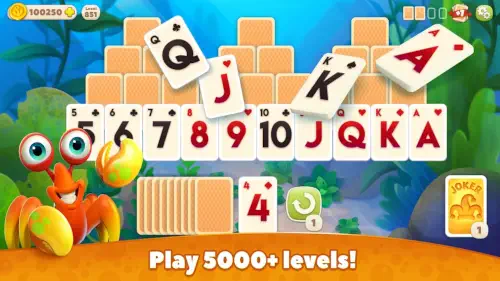
Undersea Solitaire Tripeaks is Plarium Global Ltd’s underwater casual adventure game that turns classic TriPeaks solitaire into something much larger than a card game.
Instead of simply clearing a board and moving to the next deal, Undersea Solitaire Tripeaks players use their solitaire progress to earn resources, rebuild the damaged underwater town of Rocky Bottom, follow story quests, meet more than 30 animated characters, and gradually shape the town through extensive customization.
The game combines more than 10,000 TriPeaks levels with 800+ story quests, special blockers, boosters, daily challenges, events, Club features, and thousands of town customization options. Its underwater setting also gives the game a distinct identity, with Rocky Bottom serving as both the narrative setting and the place where much of the long-term progression takes place.
What Is Undersea Solitaire Tripeaks?
Undersea Solitaire Tripeaks is a casual mobile adventure game built around TriPeaks solitaire. Its defining feature is the combination of traditional card clearing with a persistent underwater town building system. Players clear solitaire layouts, earn resources, complete quests, and use their progress to restore Rocky Bottom while following the stories of its residents.
Rather than separating the card game from the adventure elements, Plarium connects them closely. Solitaire provides the main activity, while quests, characters, construction, customization, and events give players additional objectives between card levels.
The Story Behind Rocky Bottom
Rocky Bottom begins as a damaged underwater town that needs to be rebuilt. A powerful whirlpool has left the community in disarray, creating the central reason for the player’s involvement.
The Whirlpool That Destroyed Rocky Bottom
The game’s story begins with Rocky Bottom suffering major damage after a nasty whirlpool tears through the underwater community. The destroyed town becomes the setting for the player’s reconstruction journey.
The damaged environment also gives the town-building system a clear purpose. Players are not simply placing decorations in an already finished location. They gradually help restore a community that has been disrupted by the disaster.
Rebuilding the Underwater Town
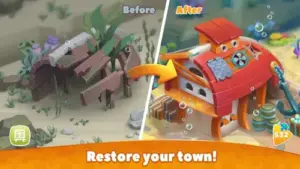
Solitaire victories help generate the resources needed to rebuild Rocky Bottom. As players progress, construction and customization become part of the reward for continuing through the card levels.
This creates a direct connection between TriPeaks solitaire and underwater town building. A completed card board is not just an isolated win because its rewards can contribute to visible changes around the town.
Alfred the Crab and the Residents of Rocky Bottom
Alfred the Crab and the town’s other residents provide much of the game’s personality. Players encounter more than 30 animated characters as they work through quests and rebuild the community.
Characters are tied to the story rather than functioning only as decorative additions. Their interactions help introduce new activities, quests, and pieces of Rocky Bottom’s history.
Ancient Artifacts, Mysteries, and Town Stories
The storyline goes beyond rebuilding damaged buildings. Players can uncover ancient artifacts, investigate mysteries, solve crimes, host activities, and encounter unusual residents and situations as Rocky Bottom develops.
These activities give the game a broader casual-adventure identity while keeping TriPeaks solitaire at the center of progression.
What Type of Game Is Undersea Solitaire Tripeaks?
Undersea Solitaire Tripeaks sits between several casual-game categories. The card board is the main gameplay activity, but the surrounding systems add adventure, narrative, construction, customization, and social elements.
TriPeaks Solitaire Card Gameplay
The primary gameplay uses the familiar TriPeaks structure. Players remove exposed cards by selecting cards that are one rank higher or one rank lower than the current waste-pile card.
The objective is to clear the three peaks while making efficient use of available cards and the stock. Suits and colors do not determine whether a card can be played, keeping the focus on rank relationships and the sequence of available moves.
Casual Adventure Elements
The game expands beyond solitaire through quests, characters, town reconstruction, mysteries, artifacts, and activities throughout Rocky Bottom.
That combination makes it different from a standalone TriPeaks app where completing the card board is effectively the entire objective.
Underwater Town Building
Rocky Bottom acts as the game’s persistent construction space. Players can rebuild areas of the town and use thousands of customization options to shape its appearance.
Buildings, decorations, and themed areas give successful solitaire sessions a visible long-term result.
Story Driven Progression
More than 800 story quests provide a narrative reason to continue progressing through the game. Completing quests can reveal more about Rocky Bottom, its residents, and the history surrounding the underwater community.
The story therefore works alongside the solitaire progression rather than replacing it.
Character Based Gameplay
More than 30 animated 3D characters populate Rocky Bottom. Characters such as Alfred the Crab, Ringmaster Raúl, and Madame Abella contribute to the game’s narrative and introduce players to different situations and activities.
Their personalities and interactions give the town a stronger sense of identity than a purely decorative city building system.
Social and Club Features
Players can also participate in the Club system, where members work toward shared goals and earn bonuses. Clubs add a social layer to a game that can otherwise be played primarily through individual solitaire levels.
Club activities and competitions provide additional objectives for players who want interaction beyond rebuilding their own town.
Who Is Undersea Solitaire Tripeaks For?
Players Who Enjoy TriPeaks Solitaire
Players who already enjoy TriPeaks will find the card system familiar, while blockers, boosters, events, and increasingly challenging layouts provide additional variation.
Fans of Story Driven Mobile Games
Players who prefer their casual games to have characters and ongoing stories may find the 800+ quests particularly appealing. Rocky Bottom gives the card gameplay a continuing narrative context.
Players Who Like Town Customization
The game is also aimed at players who enjoy rebuilding and decorating virtual spaces. Thousands of customization options allow Rocky Bottom to become more than a simple progression screen.
Casual Players Looking for Short Card Sessions
Undersea Solitaire Tripeaks works well for players who want individual solitaire sessions while still having a larger progression system to return to. A player can focus on clearing card layouts or spend more time working through quests, construction, characters, and events.
For players searching specifically for an underwater TriPeaks solitaire game with town building, that combination is the feature that gives Undersea Solitaire Tripeaks its clearest identity.
Undersea Solitaire Tripeaks Gameplay
Undersea Solitaire Tripeaks gameplay takes the familiar TriPeaks card format and connects each completed board to a larger progression system built around Rocky Bottom. The card rules are easy to understand, but the decisions become more interesting when blockers, boosters, limited stock cards, longer chains, and increasingly complicated layouts start working together.
How TriPeaks Solitaire Works
The basic objective is to remove the cards covering the three peaks. Players select an exposed card that is one rank higher or one rank lower than the card currently sitting on the waste pile. Because suits and colors do not determine valid moves, the important decision is which available card will open the most useful path through the tableau.
The Three Peak Card Layout
A traditional TriPeaks board contains three overlapping peaks made from the tableau cards. The arrangement means that removing cards from lower positions can expose cards higher in the layout, gradually opening access to the three peaks.
The layout creates a simple but meaningful decision: taking a legal card is not always the best move if another available card exposes more of the board.
The One Rank Card Rule
The central TriPeaks solitaire card rule is straightforward. If the waste pile shows a card, the player can normally remove an exposed tableau card that is exactly one rank above or below it.
For example, an exposed 8 can be followed by a 7 or 9. The suit does not matter, so the decision is based entirely on rank.
Exposed Cards and the Tableau
Only uncovered cards can be selected. Cards hidden beneath other tableau cards remain unavailable until the cards covering them have been removed.
This makes the position of every exposed card important. A move that opens two or more previously covered cards can be more valuable than simply taking the easiest available match.
The Waste Pile
The waste pile determines the next legal move. Each card played becomes the new top card, potentially opening another move and allowing the player to continue a chain.
A strong run can therefore develop from a single well-chosen card, while a poor choice can leave the player with no useful continuation.
Drawing From the Stock
When there is no useful playable card on the tableau, players can draw from the stock. The newly revealed card becomes the target for the next possible match.
Stock cards are valuable because every draw changes the available sequence. Drawing too early can interrupt a promising chain, so experienced play involves checking the exposed tableau before reaching for the stock.
Clearing All Three Peaks
The main objective is to remove the cards from the three peaks and clear the tableau. Reaching that point requires more than finding individual matches because the player must manage the sequence of available cards and the remaining stock.
Suits and Colors Do Not Affect Card Matching
TriPeaks matching is based on rank rather than suit or color. A card can be played against the waste pile whenever its rank is one higher or one lower than the current card.
This keeps the decision-making focused on the sequence of ranks and the cards that each move will expose.
Understanding Card Chains
Card chains are one of the most important parts of Undersea Solitaire Tripeaks strategy. Removing several cards consecutively without drawing from the stock can open large portions of the tableau while preserving valuable stock cards.
Playing Consecutive Cards
Suppose the waste pile contains an 8 and the tableau offers a 7. Playing the 7 changes the target, potentially allowing a 6 or 8 to follow. A sequence can continue as long as each new card is one rank away from the previous one.
Extending a Card Run
When several legal cards are available, the strongest choice is often the one that keeps the chain alive while exposing additional cards.
A long run can remove several tableau cards using a single stock card, making chain length an important part of efficient play.
Creating Longer Chains
Longer chains become easier to build when players look beyond the immediate move. Instead of asking only which card can be played now, it helps to consider which card is likely to create the next two or three opportunities.
This is particularly useful when multiple exposed cards are legal but only one opens a promising sequence.
Knowing When to Draw From the Stock
Drawing from the stock should not automatically be the next action whenever the current move becomes less obvious. First, scan the exposed tableau for another valid card.
If no useful move remains, drawing is necessary. If a playable card is available, taking it may preserve the current chain and expose additional cards.
The King to Ace Connection
The King to Ace relationship adds another useful option to the standard rank sequence.
Understanding the Wrap Around Rule
The wrap-around rule allows Kings and Aces to connect. A King can therefore be followed by an Ace, while an Ace can connect back to a King.
This relationship is easy to overlook when concentrating on the numerical sequence, but it can open an otherwise unavailable continuation.
Using King and Ace Connections Strategically
A King or Ace can become particularly valuable when it extends a chain that would otherwise end. Before drawing another stock card, check whether an exposed King or Ace can continue the current sequence.
Using the wrap around connection at the right moment can expose additional cards and preserve a longer run.
What Happens When You Clear a Level?
Completing a TriPeaks board is also part of the game’s larger progression system. Undersea Solitaire Tripeaks uses successful card play to feed into the reconstruction of Rocky Bottom.
Completing the Solitaire Board
Once the required tableau has been cleared, the level is completed. The result contributes to the player’s wider progression rather than simply ending the session.
Earning Rewards
Successful solitaire play provides resources that can be used elsewhere in the game. Gems are particularly important because they help fund construction and development in Rocky Bottom.
Using Rewards to Progress Through Rocky Bottom
The connection between card wins and town development is one of the defining features of the game. Players clear TriPeaks boards to earn resources, then use those resources to rebuild, expand, and customize the underwater town.
That creates a clear progression path from playing TriPeaks solitaire to rebuilding Rocky Bottom.
Undersea Solitaire Tripeaks Levels and Challenges
The game offers more than 10,000 TriPeaks levels, giving players a substantial amount of card content to work through. The variety comes not only from different layouts but also from blockers, boosters, changing challenges, events, and progressively more demanding boards.
10,000+ TriPeaks Levels
The large level count gives Undersea Solitaire Tripeaks its long-term card-game foundation. Players can continue moving through new layouts while simultaneously progressing through the town and story systems.
Classic TriPeaks Layouts
The familiar three peak structure remains the foundation of the card boards. Players who already know TriPeaks can immediately understand the basic objective while still having additional mechanics to learn.
Increasing Difficulty
As progression continues, layouts can become more demanding. Players need to pay closer attention to which cards they expose, how long they can maintain a chain, and when they should spend a booster.
Changing Gameplay Mechanics
Blockers, boosters, and other level-specific mechanics prevent every board from feeling identical. Their combinations can change which cards deserve priority and when a player should use a limited resource.
Long Term Level Progression
The large number of levels makes progression a major part of the game. A player can work through card boards while simultaneously unlocking additional story content, town development, and activities.
Blockers and Difficult Card Layouts
More than 15 unique blockers add obstacles to the standard TriPeaks format. Instead of simply removing cards in the most obvious sequence, players may need to consider which blocker is preventing access to valuable cards.
More Than 15 Unique Blockers
The blocker variety gives individual levels additional structure. Different obstacles can change the order in which cards should be approached and make certain moves more important than others.
Cards That Restrict Access
A blocker can prevent access to cards positioned behind it. Removing that obstacle may therefore be more valuable than taking another immediately available card.
Blockers That Hide Other Cards
When a blocker sits in a strategically important part of the tableau, clearing it can expose several new opportunities at once.
The strongest move is therefore not always the card that adds the most to the current chain. Sometimes opening the board matters more.
Planning Around Difficult Tableau Layouts
Players should look across the exposed tableau before committing to a move. If one card opens several hidden cards while another simply extends a short chain, the first option may create more opportunities for the rest of the board.
Boosters
The game includes six boosters designed to help players deal with difficult card situations. They become particularly useful when a board has limited playable cards, troublesome blockers, or an unfavorable sequence.
Six Available Boosters
The six boosters provide different forms of assistance during difficult levels. Rather than treating them as automatic solutions, players can save them for situations where their effect can significantly change the outcome.
Using Boosters on Difficult Levels
A booster is most valuable when it solves a specific problem. Using one simply because it is available can leave fewer options when a genuinely difficult board appears later.
Saving Valuable Boosters
Players who conserve boosters have more flexibility when they encounter difficult layouts. This is especially relevant as blocker combinations and level complexity increase.
Choosing the Right Booster for the Situation
The best booster depends on what is stopping progress. A blocked tableau, an unfavorable card sequence, and a shortage of available moves can each call for a different response.
Daily Challenges and Special Events
Regular activities add objectives beyond standard level progression. Daily challenges, Epic Challenges, and limited time events give players additional reasons to return to the card boards.
Daily Card Challenges
These activities encourage players to approach familiar TriPeaks mechanics under changing objectives rather than simply moving through the standard level sequence.
Epic Challenges
Epic Challenges add another layer of recurring objectives, giving experienced players additional targets beyond ordinary level completion.
Limited Time Events
Special events introduce temporary activities and rewards that can change what players prioritize during a particular period.
Special Rewards
Event rewards can provide useful resources and bonuses, giving players another reason to participate rather than focusing exclusively on standard levels.
Competitive Event Progression
Some events introduce competitive elements, allowing players to compare their progress or performance against others while pursuing event rewards.
Undersea Solitaire Tripeaks Story and Quests
The card gameplay is only one part of the progression system. More than 800 story quests connect the solitaire boards to Rocky Bottom’s residents, history, mysteries, and activities.
800+ Story Quests
The large quest count gives the game a substantial narrative layer. Instead of completing solitaire levels without context, players can work toward objectives that gradually reveal more of Rocky Bottom.
Uncovering Rocky Bottom’s History
Story quests reveal information about the underwater town and its residents while the player helps restore the community.
Completing Quest Objectives
Quests provide specific tasks that guide progression. Completing them can unlock additional story developments and activities.
Unlocking New Story Progression
As players continue through quests, the narrative expands with new characters, situations, and parts of the town.
The Characters Behind the Story
More than 30 animated 3D characters populate Rocky Bottom, giving the story a strong character-driven element.
Alfred the Crab
Alfred the Crab is one of the central characters associated with the rebuilding of Rocky Bottom. His role helps connect the player’s reconstruction efforts with the town’s residents.
Ringmaster Raúl
Ringmaster Raúl is among the game’s distinctive characters and is connected with the unusual activities and personalities found throughout Rocky Bottom.
Madame Abella
Madame Abella adds another memorable character to the town’s cast, with her illusions contributing to the game’s character focused storytelling.
More Than 30 Animated Characters
The large character cast helps prevent Rocky Bottom from feeling like a collection of empty buildings. Residents have individual personalities and connections to the quests unfolding around them.
Character Driven Gameplay
Characters are integrated into the progression system rather than appearing only as background decoration.
Character Interactions
Players encounter characters through story activities and quests, gradually learning more about the residents of Rocky Bottom.
Character Quests
Specific characters can be connected to individual quest objectives, giving the narrative a more personal structure.
Unique Personalities
Each character contributes a different personality to the underwater community, helping distinguish the various story situations.
Characters as Part of Town Progression
As Rocky Bottom develops, its residents and their activities become part of the wider progression. Town restoration therefore affects more than the visual appearance of the environment.
Story Content Beyond Solitaire
The game uses its underwater setting to introduce activities that would not exist in a basic solitaire app.
Ancient Artifacts
Players can uncover ancient artifacts while progressing through the story, adding collectible and historical elements to the town’s narrative.
Mystery and Crime-Solving Activities
Some quests involve mysteries and crime-solving situations, giving the player objectives that move beyond simply rebuilding structures.
Fashion Shows
Fashion shows are among the unusual activities that appear as Rocky Bottom develops, adding variety to the town’s ongoing story.
New Residents and Town Activities
New residents and activities gradually give the restored town more personality and make reconstruction part of the narrative rather than just an upgrade system.
Rebuilding and Designing Rocky Bottom
Rocky Bottom is the game’s main persistent environment. Players use rewards from solitaire to restore the damaged town and then customize its appearance with a large selection of design options.
How Town Building Works
The construction system connects the card game directly to the town.
Earning Gems Through Solitaire
Completing solitaire levels provides gems that can be used for town development. This creates the main economic connection between card progression and construction.
Spending Gems on Construction
Players spend their earned gems to rebuild structures and advance Rocky Bottom. Winning card levels therefore has a visible effect outside the solitaire board.
Rebuilding Damaged Areas
The damaged state of Rocky Bottom gives construction a clear narrative purpose. Players gradually transform the broken underwater community into a developed town.
Unlocking New Town Features
Progress through the game can open additional areas, activities, and customization opportunities as the town grows.
Designing Your Underwater Town
The town-building system gives players considerable freedom over how Rocky Bottom looks.
Thousands of Customization Options
Players have thousands of customization choices available for buildings, decorations, and other elements. This gives the town a more personal appearance as progression continues.
Building Placement
Buildings can be arranged within the available town spaces, allowing players to shape the appearance of different areas.
Decorations and Visual Themes
Decorations add additional visual detail, while different design choices allow players to create distinct-looking sections of Rocky Bottom.
Creating Different Town Areas
The town can develop into several types of spaces rather than remaining a simple collection of identical buildings.
Special Town Activities
Town development also unlocks activities that become part of the game’s wider story.
Circus Areas
Circus-related areas add another type of location to Rocky Bottom and connect the town’s visual development with its story activities.
Amphitheater Features
The amphitheater provides another distinctive town feature that players can develop as the community expands.
Theme Park Elements
Theme park elements contribute to the variety of activities and locations available within the underwater town.
Fashion Shows
Fashion shows combine character interaction with town activity, giving the residents another reason to interact within the restored community.
Resident Activities
As more areas become available, residents participate in different activities that contribute to Rocky Bottom’s changing identity.
Town Building as a Progression System
The construction system gives solitaire victories a persistent purpose beyond the current level.
Connecting Solitaire With Construction
The relationship is straightforward: players complete card levels, earn resources, and use those resources to rebuild Rocky Bottom.
This connection is what separates Undersea Solitaire Tripeaks from a traditional TriPeaks solitaire game.
Using Card Wins to Expand Rocky Bottom
Every successful level can contribute toward construction and customization, allowing progress on the card board to produce visible changes in the town.
Balancing Story Progression and Town Development
Players can move between solitaire levels, story quests, construction, customization, and events. The result is a progression system where card skill, resource management, narrative objectives, and town development continually feed into one another.
For players searching for a TriPeaks solitaire game with underwater town building, this connection between clearing cards and rebuilding Rocky Bottom is the defining feature of Undersea Solitaire Tripeaks.
Undersea Solitaire Tripeaks Characters and Social Features
30+ Animated 3D Characters
Undersea Solitaire Tripeaks characters give Rocky Bottom much of its personality. The game features more than 30 animated 3D characters, and they are tied to the town’s quests, activities, and unfolding story rather than existing simply as visual decoration. For players looking for an underwater solitaire game with characters and story quests, this cast is an important part of what separates the game from a traditional card app.
Character Designs and Animation
The characters use animated 3D models that fit the game’s underwater setting. Their presentation adds movement to story scenes and town interactions, making Rocky Bottom feel more like a populated community than a static solitaire backdrop.
Individual Personalities
Each character contributes a different personality to the town. That variety helps the narrative move between lighter activities, mysteries, reconstruction tasks, and other situations as players progress.
Characters Connected to Story Quests
Characters are closely connected to the game’s 800+ story quests. Interacting with residents can reveal new objectives, introduce additional story details, and provide context for why particular areas of Rocky Bottom need to be rebuilt.
The Club System
The Club system adds a multiplayer-social layer to an otherwise solo focused card game. Players can join a Club, cooperate with other members, work toward shared objectives, and earn bonuses through participation.
Joining a Club
Joining a Club gives players access to a social group built around the game’s card progression. It can also make the daily routine feel less isolated because progress happens alongside other players.
Creating a Club
Players can also create their own Club and build a group around shared goals. This gives more active community members control over who they play and cooperate with.
Working Toward Shared Goals
Club activities turn individual solitaire progress into something that can contribute toward wider objectives. Instead of every reward being tied only to personal level completion, players can participate in goals involving the entire group.
Earning Club Bonuses
Club participation can provide additional bonuses, giving players a practical reason to remain active within their group rather than treating the social system as optional decoration.
Club Events and Competition
Clubs also introduce competitive elements that give experienced players another reason to keep playing beyond the normal level map.
Club Competitions
Club competitions allow groups to compare their progress and performance. The competitive layer adds a different objective to the familiar TriPeaks format without changing the underlying card rules.
Shared Rewards
The social structure can connect group participation with rewards, making cooperation useful as well as entertaining.
Social Interaction
Club features provide opportunities for players to interact around progression, events, and shared objectives. For a casual mobile game, this gives the card gameplay a stronger community dimension.
Community Activities
Daily challenges, special events, Club activities, and character-driven content give players several ways to remain involved with the wider game community.
Why the Club System Matters
The Club system is significant because it expands Undersea Solitaire Tripeaks beyond traditional solitaire gameplay.
Playing Solitaire as a Social Activity
Traditional solitaire is normally a solitary activity. Here, individual card sessions can contribute to a larger social structure through Clubs and shared goals.
Working With Other Players
Players can pursue objectives alongside Club members rather than relying exclusively on their own progression.
Adding Long Term Goals Beyond Individual Levels
A large level map can provide plenty of content, but social objectives create another reason to keep returning. Club participation gives long-term progression a group oriented dimension.
Undersea Solitaire Tripeaks Events and Daily Activities
Undersea Solitaire Tripeaks events and daily challenges add changing objectives around the standard TriPeaks levels. Instead of simply completing the next board, players can return for limited activities, additional rewards, and competitive challenges.
Daily Challenges
Daily activities give players a reason to check in regularly and pursue objectives beyond ordinary level progression.
Daily Objectives
Daily objectives can change the immediate focus of a session, encouraging players to approach the card boards with a particular target in mind.
Challenge Rewards
Completing daily objectives can provide rewards that support wider progression, making these activities useful rather than purely cosmetic.
Building a Daily Playing Routine
For casual players, daily challenges create a natural short-session structure. A player can complete an objective, collect its reward, and then return to the main level progression when convenient.
Special Card Game Events
Special card events introduce temporary challenges and rewards that sit alongside the normal level map.
Limited Time Challenges
Limited-time activities encourage players to participate while they are available rather than postponing them indefinitely.
Event Rewards
Rewards give these temporary activities a practical purpose, particularly for players trying to build resources or move through progression more efficiently.
Competitive Activities
Some events add competition between players, creating another layer of motivation for those who enjoy comparing their performance with others.
Epic Challenges
Epic Challenges provide another recurring activity type for players who want more than the standard sequence of TriPeaks boards.
Weekly Challenge Structure
The game’s Epic Challenge structure provides changing objectives across the week, giving regular players different targets instead of repeating the exact same task every day.
Different Objectives Throughout the Week
Changing objectives can alter how players approach their sessions. One challenge may encourage continued level progression, while another can emphasize a particular form of participation or achievement.
Rewards and Progression
The rewards from recurring challenges feed back into the broader progression system, helping connect short term activities with longer-term goals.
Events and Long Term Engagement
Events are important because they keep the game’s card content from being entirely dependent on the permanent level map.
Adding Variety to Solitaire Levels
Temporary challenges introduce different reasons to play familiar TriPeaks mechanics, which can make the overall progression feel less repetitive.
Encouraging Regular Play
Daily and limited-time activities create natural return points for players who enjoy short mobile gaming sessions.
Combining Competition With Casual Gameplay
The game balances competitive activities with a fundamentally casual card format. Players can participate in events and Clubs without needing the intensity associated with traditional competitive multiplayer games.
Undersea Solitaire Tripeaks Graphics and Design
Undersea Solitaire Tripeaks graphics are built around a colorful underwater setting, with Rocky Bottom providing the visual foundation for the game’s town building and story systems. The presentation combines readable card layouts with animated characters, detailed environments, and customizable town areas.
Underwater Visual Style
The game’s visual identity is immediately tied to its ocean setting. Instead of using a conventional green felt or casino-style solitaire presentation, the card boards and surrounding environments are framed by an underwater world.
Rocky Bottom’s Ocean Environment
Rocky Bottom provides the main visual setting for the game’s reconstruction and story progression. As players develop the town, the environment becomes an important part of their sense of progress.
Ocean Themed Backgrounds
Underwater scenery and ocean inspired backgrounds reinforce the game’s setting while keeping the card gameplay visually connected to the wider town.
Underwater Buildings and Decorations
Buildings and decorations give Rocky Bottom a changing appearance. Players can place different elements and use the available customization options to shape individual areas of the town.
Card Design
The card interface needs to remain readable despite the game’s decorative underwater presentation.
Readable TriPeaks Layouts
The three-peak card arrangement is presented clearly enough for players to identify exposed cards and make decisions quickly. This is particularly important when several cards become available during a long chain.
Ocean Themed Card Presentation
The card presentation fits the underwater setting without changing the basic TriPeaks rules. The visual theme therefore supports the game’s identity while preserving the familiar card structure.
Clear Gameplay Interface
Buttons, cards, stock information, rewards, and available actions need to remain distinguishable during play. A clean interface is especially important on smaller smartphone screens.
3D Character Presentation
The game’s 30+ animated characters add another visual layer beyond the card boards and town environments.
Animated Character Models
Characters are presented as 3D animated models rather than static portraits. Their movement helps story interactions feel more connected to the surrounding world.
Character Visual Details
Different character designs help distinguish residents from one another and reinforce their individual personalities.
Story Scenes and Interactions
Character interactions are incorporated into the narrative and quest system, giving the game’s visual presentation a reason to shift between card gameplay and story content.
Town Visuals
Rocky Bottom provides a separate visual progression system because the town changes as players spend their earned resources.
Customizable Buildings
Players can develop and arrange buildings as they rebuild the underwater settlement. This makes town construction visually meaningful rather than simply increasing numerical progression.
Decorations and Environmental Details
Decorations add smaller visual elements around buildings and help players personalize their version of Rocky Bottom.
Different Areas of Rocky Bottom
The town can contain different types of locations, including circus areas, an amphitheater, and theme park elements. These areas give the underwater environment more variety as reconstruction continues.
Mobile Interface and Performance
The game’s visual presentation is designed around mobile play, where card readability and touch controls matter as much as graphical detail.
Smartphone Friendly Interface
The card layout and interface are designed for touchscreens, allowing players to select exposed cards, draw from the stock, and interact with town features without requiring complex controls.
Tablet Accessibility
The larger display of a tablet can provide additional space for the TriPeaks tableau and town interface while retaining the same mobile focused design.
2D and 3D Visual Presentation
The game combines 2D card gameplay with 3D characters and town environments. This mixture gives Undersea Solitaire Tripeaks a distinct look while supporting its unusual combination of solitaire, story quests, and underwater town building.
Undersea Solitaire Tripeaks Progression and Rewards
Earning Gems Through Solitaire
Undersea Solitaire Tripeaks progression is built around a simple connection: playing TriPeaks levels earns resources, and those resources help rebuild Rocky Bottom. This gives each successful card board a purpose beyond simply reaching the next level.
Completing Card Levels
Every completed TriPeaks board contributes to the player’s wider progress. Clearing the three peaks, dealing with blockers, extending card chains, and making efficient use of the stock all directly support continued advancement.
Using Rewards for Town Development
Gems earned through solitaire can be spent on construction and town improvements. Instead of keeping card rewards separate from the game’s adventure elements, Undersea Solitaire Tripeaks turns successful card play into visible changes around Rocky Bottom.
Connecting Level Progress With Construction
The connection between levels and construction is one of the game’s defining progression features. A player can clear several card boards, collect resources, and then use those rewards to repair or develop another part of the underwater settlement.
Story Progression
The story system gives another reason to keep progressing through the TriPeaks levels. More than 800 story quests connect card game progress with Rocky Bottom’s history and its residents.
Completing Quests
Story quests provide objectives that sit alongside ordinary level completion. Completing them can move the narrative forward while introducing new activities and interactions.
Unlocking New Areas
As progression continues, players can open additional parts of Rocky Bottom and gain access to more town activities. This gives the underwater settlement a sense of gradual development.
Meeting New Characters
New residents and story characters become part of the growing town. With more than 30 animated 3D characters, the narrative progression has a substantial cast to work with.
Town Progression
Town development turns resources earned from solitaire into a persistent visual progression system.
Constructing Buildings
Gems can be used to construct and develop buildings throughout Rocky Bottom. Construction therefore becomes a direct reward for successful card play.
Expanding Rocky Bottom
The damaged underwater town gradually becomes larger and more developed as players continue progressing. New structures and activities give the settlement a changing appearance.
Unlocking More Customization
Town development also opens opportunities to use the game’s thousands of customization options. Players can shape the appearance of Rocky Bottom rather than simply following a fixed visual layout.
Event Rewards
Events provide additional ways to collect useful rewards outside ordinary level completion.
Daily Challenge Rewards
Daily challenges can provide additional resources and incentives for returning regularly. These rewards can supplement the resources earned through normal solitaire progression.
Special Event Rewards
Limited time card events offer their own objectives and rewards. Participating while an event is active can provide opportunities that are not available through standard level progression.
Club Related Bonuses
Club participation adds another reward channel. Working toward shared goals with other players can produce bonuses that complement individual progression.
Free to Play Progression
The game’s progression is designed around free access to its basic card gameplay, while optional purchases can affect how players manage resources and progression.
Free Content Available to Players
Players can progress through the TriPeaks levels, story quests, town development, challenges, and other content without needing to purchase the basic game.
The large number of levels and extensive story content provide substantial material for players who prefer not to spend money.
Resource Management
Managing gems, boosters, and other available rewards becomes increasingly important as progression continues. Spending everything immediately can leave fewer resources available for a difficult level or important construction objective.
Potential In-App Purchase Pressure
As with many mobile casual games, optional purchases can become part of the progression experience. Players who want to move faster may encounter opportunities to spend real money on additional resources or advantages.
Managing Progress Without Overspending
Players who prefer a free to play approach can focus on daily challenges, regular level completion, events, Club participation, and careful resource use. The goal is not to eliminate spending options, but to avoid treating every difficult level or slower progression point as a reason to purchase something.
Undersea Solitaire Tripeaks Tips and Tricks
Beginner Tips for New Players
A good Undersea Solitaire Tripeaks strategy for beginners starts with understanding the card sequence rather than immediately relying on boosters. The most useful early habit is learning to recognize which move opens the most of the tableau.
Learn the One Rank Rule First
A card must normally be one rank higher or one rank lower than the card on top of the waste pile. Suits and colors do not matter.
Understanding this rule makes it easier to identify available moves quickly and avoid wasting stock cards.
Focus on Exposing More Cards
When two legal moves are available, consider which one reveals cards underneath the tableau. Opening previously covered cards can create several new opportunities.
Build Longer Card Chains
A long chain allows multiple cards to be removed without returning to the stock. Look for sequences that can continue through several ranks rather than stopping after a single move.
Avoid Drawing From the Stock Too Early
Before drawing, check every exposed card. A playable card may be available elsewhere on the tableau, and taking it could continue the current chain.
Save Boosters for Difficult Levels
Boosters are limited resources, so using one on an easy board can leave fewer options when a blocker-heavy level becomes genuinely difficult.
Watch Special Blocker Cards
Pay attention to blockers before committing to a sequence. A move that appears useful may be less valuable than one that removes an obstacle and exposes several additional cards.
Improving TriPeaks Card Strategy
Choose Plays That Reveal New Cards
The strongest move is often the one that opens the greatest number of previously hidden cards. This can create new chains and increase the number of playable options.
Clear Important Blockers First
If one blocker prevents access to several cards, removing it can have a greater impact than extending a short chain elsewhere on the board.
Compare Multiple Available Moves
Do not automatically choose the first legal card you see. When several options are available, compare their likely consequences before selecting one.
Track the Remaining Stock
The stock is a finite resource. If only a few cards remain and the tableau still contains many covered cards, prioritize moves that expose new possibilities rather than consuming draws unnecessarily.
Use the Three Peaks Efficiently
Avoid concentrating exclusively on one peak when doing so leaves the other two difficult to access. Opening different sections of the tableau can provide more useful options later in the level.
Advanced TriPeaks Strategy
Look Ahead Before Making a Move
Try to anticipate the next few cards rather than evaluating only the current move. Because much of the tableau is visible, players can often identify promising sequences before committing.
Use Rank Density to Plan Card Chains
Look at which ranks appear frequently among the exposed cards. If several nearby ranks are available, choosing a waste-pile card that connects those ranks can create a much longer sequence.
Extend a Run Before Drawing
When another legal card can continue the current chain, use it before drawing from the stock. Preserving the chain can expose more cards while saving a stock card for later.
Balance Progress Across All Three Peaks
Working through the three peaks strategically can keep more of the tableau accessible. Clearing only one section may eventually leave the remaining cards dependent on an unfavorable sequence.
Use Undo to Analyze Mistakes
Undo can be useful for understanding why a sequence failed. Rather than treating it only as a recovery button, players can use it to compare alternative moves and identify which decision closed off the most opportunities.
Plan Around King to Ace Connections
Remember that the King and Ace can connect through the wrap around rule. A King may continue into an Ace, and an Ace may connect back to a King, potentially extending a chain that otherwise appears finished.
Managing Town Progression
Good card strategy is only part of efficient Undersea Solitaire Tripeaks progression. Players also need to decide where their earned resources will have the greatest effect.
Spend Gems Carefully
Avoid spending gems simply because a construction option is immediately available. Consider which development objective contributes most to current story or town progression.
Prioritize Useful Construction
Construction that opens new areas, activities, characters, or progression opportunities can be more valuable than spending resources purely for cosmetic changes.
Continue Story Quests
Story quests help connect town development with Rocky Bottom’s narrative. Keeping quest objectives in mind can prevent progression from becoming solely focused on decorating the town.
Use Free Customization Options
The game offers thousands of free customization choices, allowing players to personalize Rocky Bottom without treating every visual improvement as a reason to spend additional resources.
Making Better Use of Events and Clubs
Complete Daily Challenges
Daily challenges can provide additional rewards while requiring only short sessions. Completing them regularly can supplement normal level progression.
Participate in Special Events
Limited-time events can provide extra objectives and rewards, so checking the current event schedule can help players make better use of their playing sessions.
Join an Active Club
An active Club can provide more opportunities for cooperation, shared objectives, bonuses, and social interaction.
Work Toward Shared Club Rewards
Club participation becomes more valuable when members contribute consistently toward common goals. Instead of treating the Club as a passive membership, players can use it as another progression channel alongside solitaire levels, story quests, and town development.
What Players Like About Undersea Solitaire Tripeaks
Large Number of Solitaire Levels
10,000+ TriPeaks Levels
One of the strongest reasons players stay with Undersea Solitaire Tripeaks is the sheer amount of card content. With more than 10,000 TriPeaks levels promoted in the game’s listing, the game gives solitaire fans a substantial progression path rather than a small collection of repeatable boards.
Variety Through Blockers and Boosters
The card gameplay gains variety from more than 15 unique blockers and six boosters. That combination matters because later boards are not simply about repeating the same card-matching pattern. Blockers can restrict access to useful cards, while boosters can provide a way through awkward layouts when a normal sequence is not enough.
Underwater Story and Characters
Rocky Bottom’s Story
The underwater setting gives the solitaire boards a reason to exist beyond simply clearing cards. Players are rebuilding Rocky Bottom while gradually opening up more of its story, creating a connection between winning card levels and developing the town.
800+ Story Quests
The game’s 800+ story quests add a substantial narrative layer to the TriPeaks format. Instead of moving from one solitaire board to another with little context, players can follow quests that reveal more about Rocky Bottom and its residents.
30+ Animated Characters
More than 30 animated 3D characters give the story a recognizable cast. Characters such as Alfred the Crab, Ringmaster Raúl, and Madame Abella are tied to the game’s activities and quests, making the town feel more like a continuing story than a static backdrop.
Town Building and Customization
Thousands of Design Options
For players searching for an Undersea Solitaire Tripeaks town customization game, the design system is one of its more distinctive features. Rocky Bottom can be rebuilt and decorated using thousands of customization options, giving players something personal to work on between card sessions.
Rebuilding Rocky Bottom
Solitaire wins feed into the town-building side of the game through resource rewards. The damaged underwater settlement therefore becomes part of the progression rather than simply serving as background scenery.
Creative Town Design
The customization system lets players arrange buildings and decorations while developing different areas of Rocky Bottom. This gives the game a second form of progression for players who enjoy creating their own version of the underwater town.
Events and Daily Content
Daily Challenges
Daily challenges give regular players another reason to return beyond their normal level progression. They introduce short-term objectives and rewards without requiring players to abandon the main TriPeaks progression.
Special Card Events
Limited time card events add additional objectives around the familiar solitaire mechanics. Their temporary nature can make the same basic card system feel different from ordinary level progression.
Epic Challenges
Epic Challenges add another layer of scheduled activity, giving players additional goals alongside story quests and regular solitaire boards.
Social Gameplay
Club Features
The Club system gives Undersea Solitaire Tripeaks a social component that classic solitaire normally lacks. Players can join a Club, participate in shared activities, and work toward rewards with other members.
Shared Goals
Shared objectives provide a reason to keep playing beyond personal level completion. Instead of every session being entirely individual, Club activities can connect progress with a wider group.
Club Competition
Club related competitions and activities add a light competitive element to an otherwise casual card game. This is particularly appealing to players who want social progression without turning the entire game into a head to head multiplayer experience.
Graphics and Presentation
Underwater Visuals
The underwater presentation is one of the game’s clearest identity markers. Rocky Bottom uses ocean-themed environments, aquatic decorations, and colorful surroundings to separate the game from more conventional solitaire titles.
3D Characters
The animated 3D character presentation helps give the story scenes more personality. Characters are not simply names attached to quest text; they appear as part of the game’s visual presentation and interactions.
Detailed Town Environments
Rocky Bottom also benefits from its combination of buildings, decorations, and environmental details. As players rebuild the settlement, the visual state of the town changes alongside their progression, reinforcing the connection between solitaire rewards and construction.
Common Criticisms of Undersea Solitaire Tripeaks
In-App Purchase Concerns
Premium Spending
Like many free to play mobile games, Undersea Solitaire Tripeaks combines free progression with optional in-app purchases. For players who want to progress without spending, the important question is how comfortably the available resources support continued play.
Resource Restrictions
Gems, boosters, and other useful resources can influence how quickly players progress. When resources become scarce, players may need to decide whether to wait, continue earning through gameplay, or consider a purchase.
The Free to Play Experience
Energy and Playtime Limitations
Players looking for long uninterrupted solitaire sessions may find resource or playtime restrictions more noticeable than someone who plays in shorter sessions. This distinction matters because the game is designed around a broader progression system rather than unlimited card rounds.
Potential Restrictions on Extended Sessions
The combination of progression resources, difficult levels, and limited use boosters can naturally put boundaries around extended play. For casual players, that may be less problematic, while dedicated solitaire players may notice the limits sooner.
Managing Available Resources
Resource management becomes increasingly relevant when players encounter harder boards. Spending every available booster or resource immediately can leave fewer options when a genuinely difficult level appears.
Difficulty Spikes
Harder Solitaire Levels
The gradual increase in challenge is useful for keeping 10,000+ levels from feeling identical, but it can also create noticeable difficulty jumps. A player who moves comfortably through several boards may suddenly encounter a layout that demands better planning or a well-timed booster.
Challenging Blocker Combinations
Blockers become particularly important when several appear together. A difficult combination can restrict access to multiple cards and make an otherwise promising sequence much harder to complete.
Booster Management
Boosters can make difficult layouts more manageable, but relying on them too heavily can create resource problems later. Players who treat every difficult board as a reason to spend a booster may find progression less efficient over time.
Undersea Solitaire Tripeaks Compared With Similar Games
Solitaire Story TriPeaks Cards
Similar TriPeaks Gameplay
Players coming from Solitaire Story TriPeaks Cards will find the basic card logic familiar. Both games build their progression around TriPeaks solitaire, where players clear exposed cards by creating sequences from the current waste pile card.
Different Meta Game Structure
The major distinction comes after the cards are cleared. Undersea Solitaire Tripeaks connects its TriPeaks boards to Rocky Bottom, story quests, character interactions, town construction, and customization. This gives the card gameplay a stronger connection to a persistent underwater settlement.
TriPeaks Solitaire Card
Ocean Themed Card Gameplay
TriPeaks Solitaire Card is another option for players who prefer solitaire with an aquatic presentation. Its ocean setting makes it an obvious comparison for anyone searching for an underwater TriPeaks solitaire game.
Similar Underwater Appeal
Both games use the ocean as part of their visual identity, but Undersea Solitaire Tripeaks puts considerably more emphasis on Rocky Bottom as a developing location. The underwater environment is tied to characters, quests, buildings, and story progression rather than functioning only as a visual theme.
Solitaire Grand Harvest
Solitaire and Town or Farm Progression
Solitaire Grand Harvest follows the same broad idea of combining solitaire with a larger progression system. Successful card play contributes to development outside the individual solitaire board.
Differences in Setting and Meta Gameplay
The biggest difference is the setting and the type of progression surrounding the cards. Undersea Solitaire Tripeaks uses Rocky Bottom, underwater residents, story quests, and town customization, while Solitaire Grand Harvest is built around a farm-themed setting.
June’s Journey
Story Driven Casual Gameplay
June’s Journey appeals to players who enjoy a strong narrative layer alongside casual mobile gameplay. Its emphasis on characters, locations, mysteries, and story progression makes it relevant to players who like the narrative side of Undersea Solitaire Tripeaks.
Differences From TriPeaks Mechanics
The two games differ substantially in their primary gameplay. Undersea Solitaire Tripeaks uses TriPeaks card boards as the main activity, while June’s Journey centers its progression around hidden-object scenes and a continuing mystery narrative.
Solitaire Cruise
TriPeaks Gameplay and Events
Solitaire Cruise is another useful comparison for players interested in TriPeaks levels combined with events and longer term progression. The familiar card structure makes the two games easy to compare from a gameplay perspective.
Travel Themed Presentation
Where Undersea Solitaire Tripeaks builds its identity around Rocky Bottom and an underwater community, Solitaire Cruise uses a travel-focused presentation. The difference is largely in the world surrounding the card boards and how progression is framed.
Solitaire by MobilityWare
Traditional Solitaire Focus
Solitaire by MobilityWare is a better fit for players who primarily want traditional solitaire rather than a large narrative and town building system. Its appeal comes from straightforward card gameplay and familiar solitaire progression.
Differences in Progression and Story
Undersea Solitaire Tripeaks adds considerably more outside the card table. Story quests, characters, Rocky Bottom construction, Clubs, events, and customization make it closer to a casual adventure game built around solitaire than a traditional solitaire app.
Conclusion
Undersea Solitaire Tripeaks is a strong match for casual solitaire players who want more than a traditional card app. It makes particular sense for people who enjoy TriPeaks gameplay alongside story quests, character interactions, town customization, and regular events.
Players who like underwater settings also have a clear reason to try it. Rocky Bottom is not simply decorative scenery. Rebuilding the town gives solitaire victories a tangible purpose and creates a progression link between the card table and the wider game world.
If you enjoy TriPeaks solitaire and want a longer progression system around it. The game’s strongest advantages are its 10,000+ levels, 800+ story quests, 30+ animated characters, extensive Rocky Bottom customization, blockers and boosters, events, and Club features.
It is less convincing for players who want pure solitaire, unrestricted long sessions, or a heavily competitive card experience. But for anyone searching for an underwater TriPeaks solitaire game with town building and story quests, Undersea Solitaire Tripeaks offers a distinctive combination that is easy to understand and capable of keeping casual players busy for a long time.
Frequently Asked Questions About Undersea Solitaire Tripeaks
Where can I download Undersea Solitaire Tripeaks?
If you are looking for an Undersea Solitaire Tripeaks download, the safest option is the official Google Play listing from Plarium Global Ltd. The game is free to download and play, although it contains ads and optional in-app purchases. Players can also check Plarium’s official game resources for additional information and support.
Is Undersea Solitaire Tripeaks free to play?
Yes. Undersea Solitaire Tripeaks is free to download and play, with optional purchases available inside the game. Its main progression combines TriPeaks card levels with rewards used for rebuilding Rocky Bottom, progressing through quests, and developing the underwater town.
How many levels are in Undersea Solitaire Tripeaks?
Undersea Solitaire Tripeaks features more than 10,000 TriPeaks levels, with boosters and blocker cards adding extra variation to the card boards. The game also connects level progression with Rocky Bottom’s town development and its wider story.
Does Undersea Solitaire Tripeaks have story quests and town building?
Yes. The game combines TriPeaks solitaire with more than 800 story quests and the reconstruction of Rocky Bottom. Players earn rewards from solitaire levels and use them to complete tasks, progress through the story, and improve different areas of the underwater town.
Where can I find Undersea Solitaire Tripeaks help, updates, and community information?
For reliable information, players should start with Plarium’s official Undersea Solitaire Tripeaks Help Center and official community channels. These resources can be useful for checking gameplay mechanics, events, support information, and announcements. A dedicated independent wiki for the game is not as established as the official resources, so official support is the better reference for current information.